Unsolved Cases: Whatever Happened to Misfit (Charlotte Gage-Radcliffe)?

Disclaimer: As an Amazon Associate, we earn from qualifying purchases (Affiliate Disclosure). Thanks!

After briefly crossing her path while reading Batman: Battle for the Cowl and Final Crisis, I was reminded of Misfit (aka Charlotte Gage-Radcliffe). I checked when she last appeared in the pages of a comic. It turns out she did make a cameo in Cheetah and Cheshire Rob the Justice League #4 by Greg Rucka and Nicola Scott (who created the Misfit costume originally), published last November (2025, for reference). That was the first appearance in over a decade! And I barely consider that relevant.

In the late 2000s, Oracle’s inner circle was expanding, and no new recruit had more breakout potential than Charlotte Gage-Radcliffe. Dressed in a homemade, stitched-together Batgirl costume and shouting her trademark battle cry (“Dark Vengeance!“), Misfit brought a chaotic, endearing energy to Metropolis and Gotham.

She had the powers, the tragic backstory, and Gail Simone writing her. So, what happened to Misfit?
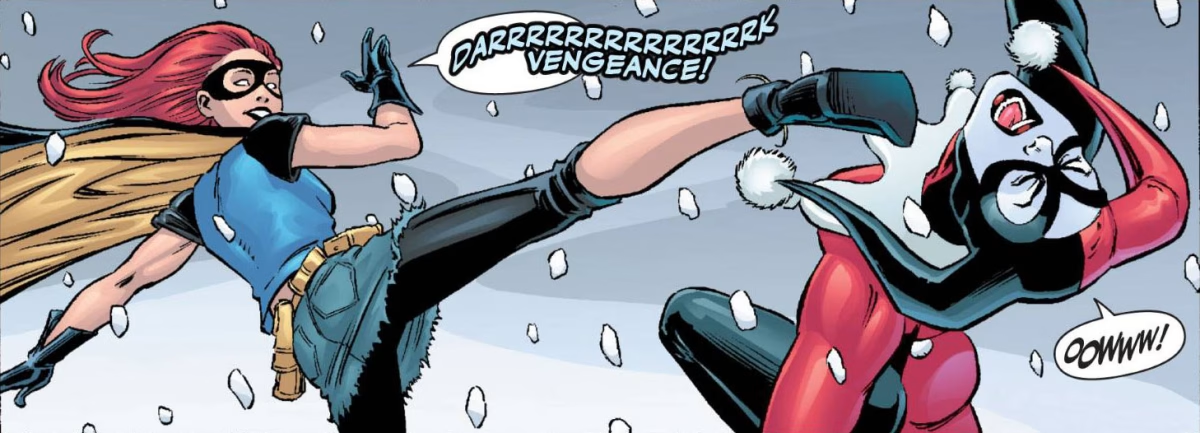
Birds of Prey #106

The Evidence: Who was Misfit?

According to Gail Simone, Misfit was created after DC editorial prevented her from using Stephanie Brown, who was considered permanently dead following “War Games.” And when I say “according to” Simone, it seems that she has discussed this in convention appearances and online Q&As, although I have not found a single published interview that contains the complete account (if you have, let me know, I’d update the article!).

What I found out, though, was that Misfit was thought of as Oracle’s Bat-Mite, which makes sense once you know it (here is the source).

When I first thought of the character, she wasn’t really much of a character in her own right..she was designed to be a pest, a less-goofy-but-still-annoying Bat-mite style character specifically for Oracle.  I love Oracle, I loved writing her. But her life was so ordered and so removed from other people in some ways that a little chaos now and then really made for fun stories.  So I created Misfit, who originally took over the Batgirl mantle without anyone’s permission.

I gave her teleportation powers (the ‘bounce’), partly in tribute to Bat-mite, and partly because it was the EXACT power that would make her the biggest pest to Oracle.  She could bounce past even the best security, and would show up at the worst possible times.
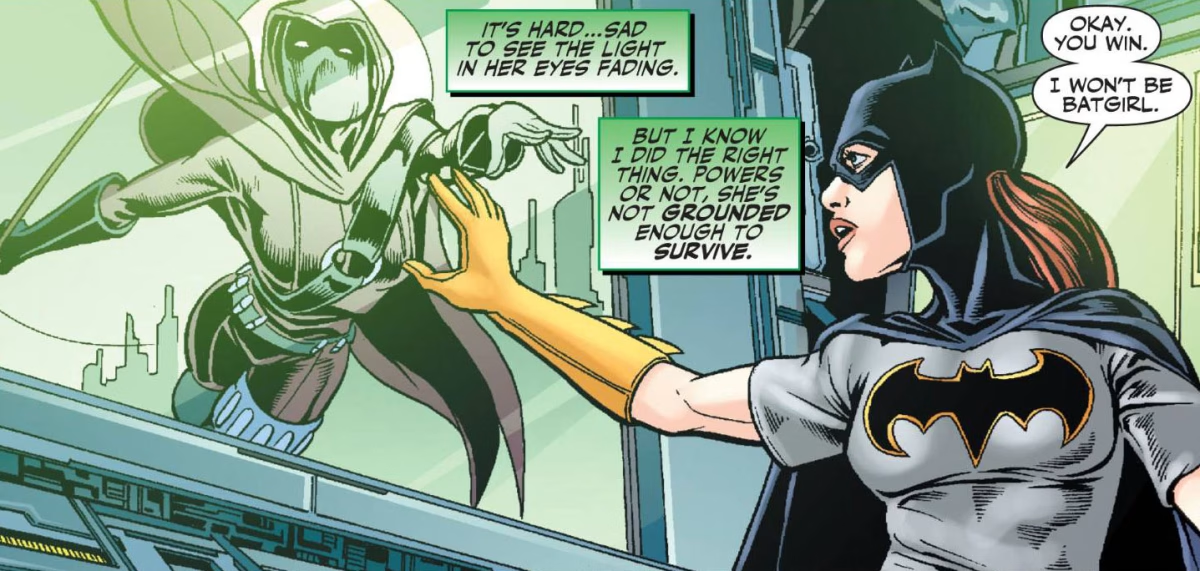
Birds of Prey #99

Introduced in Birds of Prey #96 (2006) by Simone and Paulo Siqueira, Charlotte Gage-Radcliffe lost her family in a fire that could have been avoided if the landlord had maintained his apartment building up to code, but he had chosen instead to bribe the safety inspectors. She only survived because she possessed a unique form of teleportation she called “bouncing.”

Alone in the streets of Gotham, this Batgirl’s fan started her crime-fighting career by donning the name of her idol and wearing a homemade costume, which attracted the attention of Barbara “Oracle” Gordon, who sent after her the Birds of Prey. Ultimately, she asked Babs to become the new Batgirl, but was convinced to stop wearing that costume.

Charlie didn’t promise she wouldn’t continue her crime-fighting activities, though, and she came back not long after under the identity of “Misfit.” And when Oracle learnt about what happened to her family, she took her in. Their relationship was not without complications, as Misfit didn’t always do what she was told, and it had deadly consequences.

Having failed to join the Teen Titans and with the end of Birds of Prey, Misfit appeared less often, but still kept fighting crime and even joined Wonder Woman’s team (in Wonder Woman #600).

The Editorial Erasure: Why the Case Went Cold

Misfit didn’t suffer a tragic, in-continuity death. She was a victim of the aléas of the publishing world, it seems.

When DC Comics launched the New 52 reboot, decades of history were compressed or deleted. The Birds of Prey were radically restructured, Barbara Gordon was out of her wheelchair and back in the batsuit as Batgirl, and Charlotte was mostly left out, except for an appearance in Batgirl (vol. 4) #34, by Gail Simone and Fernando Pasarin, where she briefly dispensed some “Dark Vengeance!” while assisting Barbara Gordon. It was Simone’s last written issue for this Batgirl volume, so Misfit didn’t come back after.

Scott Lobdell wanted to have her in his Teen Titans book, but DC editorial was apparently confused about her costume and, by the time things got cleared up, it was too late.

…apparently, Scott Lobdell likes the character of Misfit and wanted to use her in the New Teen Titans, which would have delighted me. But, because an editor thought the ”M” on her shirt was a bat-symbol, they thought that Misfit was still tied too closely to the bat-family and she was dropped from the roster. I tried to explain that it’s an ‘M,’ not a bat, but by the time the mistake was realized, it was too late for her to be on the team. Weird! But it was nice of Scott to try, he was actually great about it. It’s no harm done, it’s an understandable mistake, but it’s a shame, Titans is a hit book and she would be great in the new 52 (source).
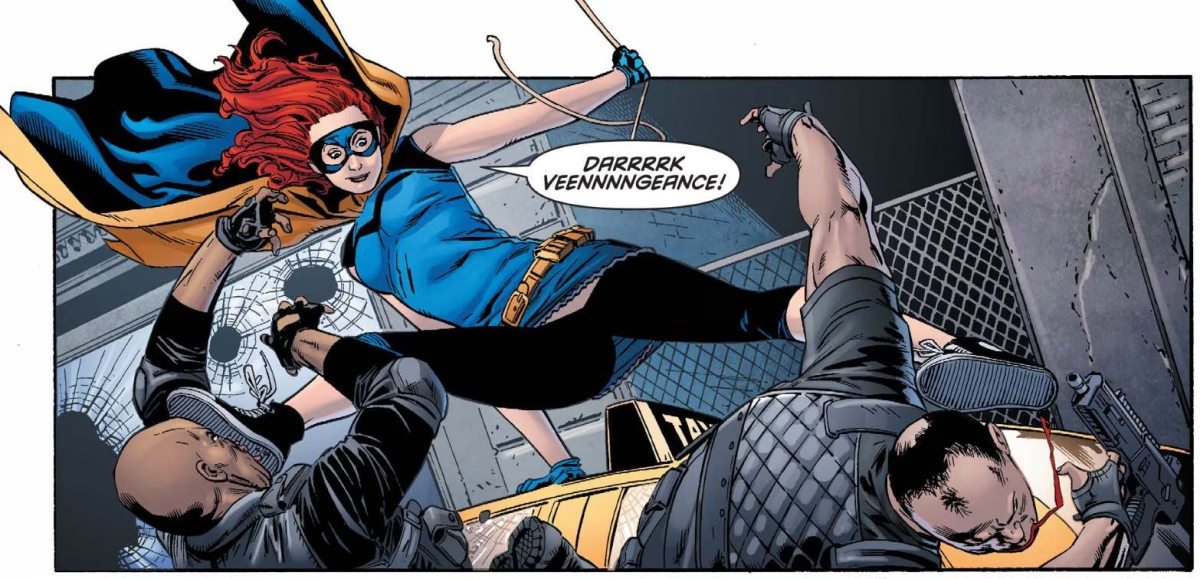
Batgirl (vol. 4) #34

As a result, we never get to learn about her real origins, but here is what Gail Simone had planned for that:

Finally, a little reveal.  I don’t know if they ever would have let me do this, but the parents we saw in her origin were not her real family. They were her adopted family.

My story was that Charlotte Gage-Radcliffe wasn’t born here at all.  She was born on Gemworld. That’s right, like Princess Amethyst, Misfit was Gemworld Royalty, princess of the Ruby House.  When her family was killed, she was sent to Earth to hide, and her memory (except for her power to bounce and her phenomenal fighting skills), were erased (source).

The Modern Status: Where is She Now?

While the DC Rebirth and Infinite Frontier eras have restored much of the pre-Flashpoint history, Misfit remains entirely sidelined. That cameo in Cheetah and Cheshire Rob the Justice League #4 was Nicola Scott seizing the moment to play once more with an old favorite, I guess.

I see no reason Charlotte Gage-Radcliffe could not be brought back. Why not in the next Birds of Prey series? If that happens, I’ll gladly update this article!

More Files from the Casebook

  • The Origin Story of DC Comics and the Golden Age of Comics

    Disclaimer: As an Amazon Associate, we earn from qualifying purchases (Affiliate Disclosure). Thanks!

    The History of DC Comics started when Major Malcolm Wheeler-Nicholson, already well-established in the printing industry, set up National Allied Publications and launched New Fun: The Big Comic Magazine in 1935. This was an oversized tabloid edited by Lloyd Jacquet. It worked well enough to justify the launch of another title, New Comics. Soon, the format changed (from tabloid to a more popular half-tabloid trim size) and the title too, as New Fun became More Fun Comics.

    To meet the needs of this new successful venture, Wheeler-Nicholson started working with the printer and distributor Independent News, the company of Harry Donenfeld, who was also interested in investing in this new emerging market.

    Read More “The Origin Story of DC Comics and the Golden Age of Comics”
  • The Black Casebook: Deconstructing the Silver Age Ghosts of Grant Morrison’s Batman

    Disclaimer: As an Amazon Associate, we earn from qualifying purchases (Affiliate Disclosure). Thanks!

    To a reader who is not all too familiar with Batman comics, Grant Morrison’s Batman run can, at times, feel like a fever dream. Why is there a “Bat-Mite”? Who are the “International Heroes”? The answer lies in The Black Casebook, a meta-fictional journal where Bruce Wayne recorded every encounter that defied logic, physics, or sanity.

    When I first read this run, my knowledge of Batman was limited to recent publications. I lacked a broader understanding of what the character went through. Even some recurring characters were not known to me. I caught up quickly, as the stories Morrison wrote don’t require you to be a Dark Knight scholar to be understood, but the more you know, the more you can appreciate what the author did.

    So, in this DC Casebook investigation, we strip away the modern shadows to reveal the 1950s and 60s “Golden & Silver Age” stories that Morrison transformed into psychological pieces to explore the mind of the Bat.

    Read More “The Black Casebook: Deconstructing the Silver Age Ghosts of Grant Morrison’s Batman”
  • The Man of Tomorrow, Reborn: A Deep Dive into John Byrne’s Superman (1986-1988)

    Disclaimer: As an Amazon Associate, we earn from qualifying purchases (Affiliate Disclosure). Thanks!

    In the mid-1980s, Superman was in trouble. Decades of ‘Silver Age’ excess, such as super-dogs, pocket dimensions, and limitless powers, had made the Man of Steel feel both invincible and rather out of touch with the times. Following the universe-shaking ‘Crisis on Infinite Earths’, DC Comics did the unthinkable and recruited Marvel superstar John Byrne to rewrite Superman’s mythology.

    The result was a fundamental shift in perception that still influences how we view Clark Kent today. Whether you are an avid collector or a new reader exploring these issues in digital archives, Byrne’s work remains the definitive ‘modern’ starting point.

    Read More “The Man of Tomorrow, Reborn: A Deep Dive into John Byrne’s Superman (1986-1988)”
  • The Batman Case Files: Introduction to Grant Morrison’s Masterpiece Run (2006-2013)

    Disclaimer: As an Amazon Associate, we earn from qualifying purchases (Affiliate Disclosure). Thanks!

    Grant Morrison’s seven-year run on Batman is widely considered one of the most ambitious long-form epics in the history of modern comic books. Running across multiple titles from 2006 to 2013, the story functions as a massive three-act saga that breaks down Bruce Wayne before rebuilding him on a global scale.

    As it is a big read, this may not be the most inviting entry point for new readers. But it’s one influential run that continues to impress and, at times, leave a little confusion. It’s a dense and coherent narrative driven by big ideas, fueled by deep cuts into obscure DC lore.

    This article presents Grant Morrison’s run, outlining the key ideas, plot points, and characters. It serves as a roadmap providing context for my detailed reading order and retrospective review. So, let’s start exploring this rich case file!

    Of course, Morrison was not alone. During his run, he worked with artists Andy Kubert, J.H. Williams III, John Van Fleet, Tony Daniel, Ryan Benjamin, Lee Garbett, Frank Quitely, Philip Tan, Cameron Stewart, A,dy Clarke, Frazer Irving, Scott Kolins, Chris Sprouse, Ryan Sook, Yanick Paquette, George Jeanty, David Finch, Scott Clark, and Chris Burnham.

    Read More “The Batman Case Files: Introduction to Grant Morrison’s Masterpiece Run (2006-2013)”
  • My Complete DC Roadmap: Key Runs, Events, and Milestones

    Disclaimer: As an Amazon Associate, we earn from qualifying purchases (Affiliate Disclosure). Thanks!

    Navigating nearly nine decades of DC Comics can feel less like diving into a universe and more like trying to map an infinite multiverse without a compass. Since Action Comics #1 debuted in 1938, so many creators have contributed to stacked timelines on top of resets, birthed golden-age legends, spun off dark-fantasy imprints, and launched cosmic-level crises. For seasoned fans seeking forgotten gems or new readers overwhelmed by where to begin, the sheer volume of material often makes knowing what to read the hardest part of the journey.

    That’s exactly the problem I faced recently (at the time of writing) while exploring possibilities for my next reading project for DC Casebook. As a result, I started looking into essential creator runs, historical milestones, monumental events, and obscure gems that shaped DC Comics history, from the sci-fi boom of the Silver Age to the mature dread of Vertigo and the modern ever-expanding universe. It soon spun out of control. What I came up with is what I call my DC Roadmap. It’s not exhaustive. It’s not definitive either. It’s full of runs, a lot I have not read, too. I just dig into the DC Comics catalog to look for books with a good reputation. I also tried to cover many of the big characters, because I have the ambition to read about some I barely know about.

    Simply put, it’s my way of getting a grasp on the evolution of the DC Universe, a tentative blueprint for the very best, or at least the most intriguing, DC has to offer. I’m open to more suggestions. The roadmap will never end.

    🚩Note on the organisation of the list: It’s not strictly chronological in terms of reading order, as I based it on start and end dates without giving it much further thought. When I explore a run, I’ll write a guide, but in the meantime, consider this a starting point, nothing more.

    Read More “My Complete DC Roadmap: Key Runs, Events, and Milestones”

Leave a Reply

Your email address will not be published. Required fields are marked *