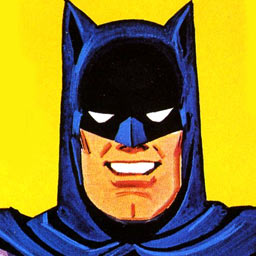

Is Grant Morrison’s Epic Batman Run Still Worth the hype? A 2026 Retrospective Review
In 2006, when Grant Morrison took over the flagship Batman title, he decided that all of the character’s publication history was, in fact, canon. The most outlandish tales were probably just the result of his view of real events distorted by all the drugs, commotions, and otherworldly experiences his crime-fighting adventure subjected him to.
That’s the idea behind the selected stories in the Black Casebook. He took concepts, and sometimes just names, out of those old comics and went on creating a unified narrative to explore Batman as an idea. But Morrison being Morrison, the run went epic, cosmic, and at times quite confusing.
Two decades later, those stories have become highly influential, and it makes sense to revisit this era that introduced Damian Wayne, made the Batman of Zur-En-Arrh into a psychological construct, redefined the bats as a symbol integral to Gotham and the Waynes’ history, and took the brand global!
Returning to Grant Morrison’s Batman run helped me to organise my reading order, but I also wanted to share my thoughts on it in a retrospective review. Let’s begin.

1. Damian, Son of Batman
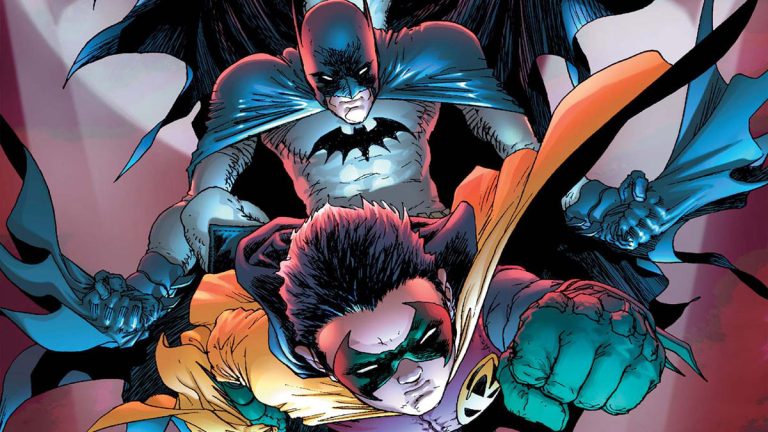
It’s strange to look back and realise that this little guy has been around kicking ass for twenty years already. Damian Wayne was certainly not the most welcome addition to the Bat-Family back then. He started by hurting Tim Drake and treating everybody with disdain. It’s clear that, contrary to many readers and writers nowadays, Morrison never thought that superhero comics needed to be grounded in reality and delivered his response to the criticism about the whole concept of a kid being the sidekick.
Damian is not your typical child. He was conceived to become the ultimate warrior whose body his granddad was going to take control of. He grew up educated by killers, without his parents. But he picked up on the respect his elders showed toward Batman and, when the situation presented itself to him, he decided that if he had to prove his worth to someone, it was to his father. He is a kid, though, and as intelligent and skilled as he can be, his arrogance, stubbornness, and lack of real-world experience made for a rough start in Gotham.
Tim was a popular Robin. He was there for a long time. So, replacing him with basically a deadly brat was a risky choice. For me, the problem is that DC Comics didn’t know what to do with Tim after that. He never became someone iconic like Nightwing. This added complications to the transition between him and Damian as Robin (naming him “Red Robin” was not enough to cut the cord properly). Nevertheless, the failure that was Jason Todd was not repeated. Damian gradually went into his own, especially as a good partner for Dick. He added unpredictability. He made mistakes, but learned from them, and he was a capable fighter from the start. It was easy to reject him at first, but Morrison wrote a solid character arc for him which carved a legitimate place for this Robin in the family.
If you question the idea of putting kids in arms way to fight crime in costume, just look at Damian Wayne, because he was born to do exactly that. The danger would be not having him at Batman’s side. At least, if you are following comic book logic. In the real world, all of this would be nonsense.
2. Always prepared. For anything. The Batman Way.
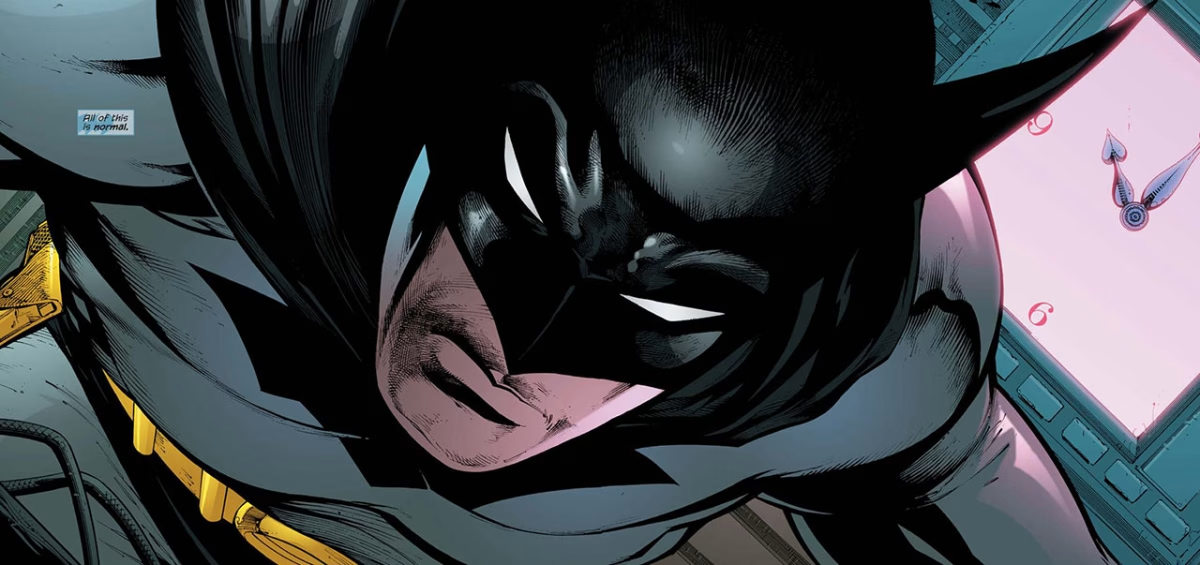
Some writers have a hard time writing for a character like Superman. It’s difficult to find new ways to create stakes when your hero is basically a god. Is it easier to write for Batman, a human who is prepared for anything? Well, it’s probably easier to dismiss this idea when it’s convenient. However, Grant Morrison didn’t shy away from the challenge of testing the Dark Knight’s level of preparedness.
That’s something that feels, at times, like an easy cop out. The Black Glove’s plan didn’t play perfectly because Batman was prepared with… a “back-up personality.” Once again, it’s comic book logic. The outlandish is treated as serious fact. For some readers, the Batman of Zur-En-Arrh may be ridiculous, no matter what, but the way the whole story leading to its appearance was conceived completely legitimised it.
That’s one of the main qualities of Grant Morrison’s writing. Something that can be challenging, especially when you read monthly, and it took years to see elements previously introduced fall into place. While revisiting this run, I was surprised by how early some key story bits were introduced. I remembered the payoff, so I picked up on them immediately. And I appreciate that it is expected of me, as a reader, to truly engage with the material. But also, that’s how Batman’s legendary preparedness makes more sense. The clues are there, and he, the greatest detective, has to calculate all the possibilities and prepare for them. So, when things unfold, it’s easier for us to accept that Batman had prepared for everything. That’s something I feel Morrison made work pretty consistently.
3. The Many Faces of Batman
It seems that, at some point, it was established that Bruce Wayne is the real mask, and Batman is the dark reality. Grant Morrison went the other way. During the Black Glove storyline, Batman is separated from Bruce Wayne. As a result, we see that Bruce’s humanity is the most important component of their relationship. Without it, Batman would simply be a monster.
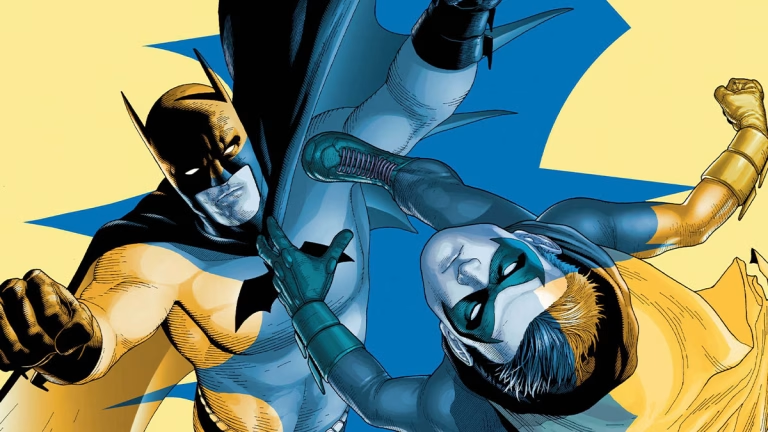
It’s a compelling argument. One that gains even more sense when Dick Grayson became Batman. Bruce didn’t want Dick to become Batman. Not that he thought he was not capable, but because Dick was Nightwing. He made something of himself. It’s why Jean-Paul Valley became Batman after Knightfall. This time, though, Dick won the cowl, only to stop anyone else (mainly Jason Todd) from wearing it and stain Bruce’s legacy.
I think it was an interesting idea to explore, and it turned out really well. The Nightwing series had lost steam, and this ended up being an interesting pivot for the character and for the whole concept of Batman. Having Damian as Robin made everything work because Dick is not Bruce. Damian adds the edge that Dick lacks, enabling him to rise to the occasion properly. A good illustration of what that Batman Legacy is all about. And a great way to show the Bat-family as more than the extension of one man. There was briefly the idea of the Network during The Battle for the Cowl. It came from Cassandra realising that you can’t replace Batman with one man, but you can do it with one team. This was not what was argued for at that moment, but Dick and Damian proved to be that team.
When you take Bruce away and put Dick in his place, Batman may look the same, but he is different. I always like that Dick is a more social Batman, that he apprehends criminals in a more law-conscious way. He was a cop after all, and unlike Bruce, he always loved to make a good show. He is not as good a detective, though, and that’s where Damian’s and Alfred’s contributions were invaluable. But he has that humanity Jason Todd lacks. The element that keeps Batman from being a monster.
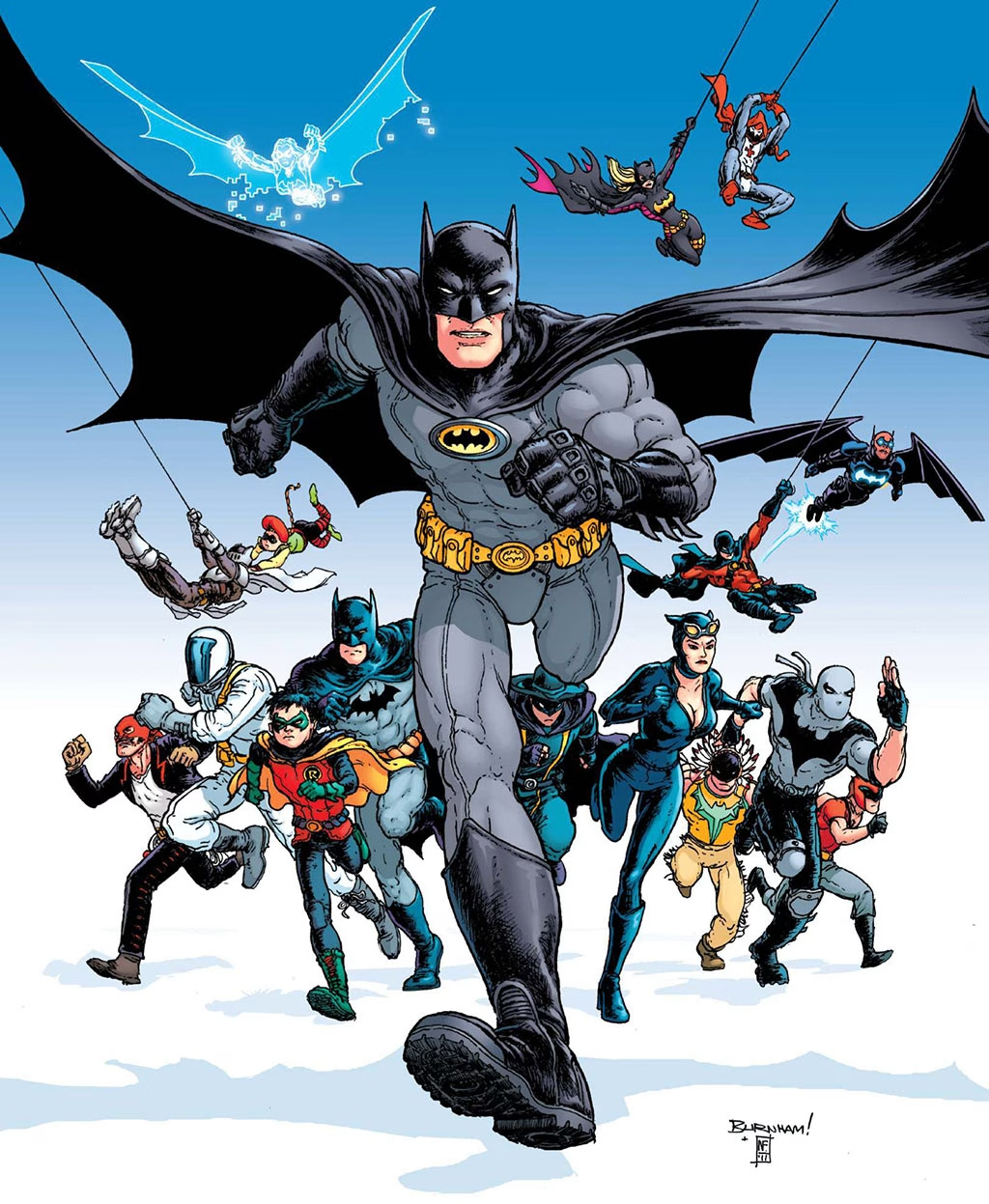
During the Batman Incorporated era, Grant Morrison went even further by multiplying Batmen. He created a consortium of crime fighters under one symbolic brand. Jiro Osamu became Batman Japan because he had what it takes to wear the cowl. Being Batman is about fighting crime. Ultimately, the corporate experiment failed, but the idea is still strong.
I’m all for having Bruce Wayne as a full-fledged character, a man who put on the cowl to fight crime, and not as the hollow public costume Batman wears during the day. I’m also all in for more Dick Grayson as Batman, and for more adventures with international Batmen. None of them will ever be as good as Bruce Wayne, but as they all show their differences, they also all prove that Batman is the more human of the superheroes.

4. Beyond the Regular Rogues Gallery
Grant Morrison’s run starts with the idea that the work is done. Gotham has been cleaned up. Of course, this didn’t last long, but with classic rogues put behind bars, the door was open for new ones. Only the Joker really has a role to play, and he almost doesn’t feel like himself. Like with Batman’s preparedness, Morrison stuck strongly with some of Joker’s specific personality traits, notably his own obsession with details. He always overdoes it to make the best “joke.” Also, he can’t be the Joker if his Batman is not here to play with him.
These are the key elements to bear in mind when trying to understand this interpretation of the Joker, especially given that the character is sometimes far more unsettling than in previous incarnations.
But beyond Joker, we’ve got many new villains. The Black Glove is the most notable. Combined with “Doctor Hurt’s” origins, the whole concept feels like an inspiration for the Court of Owls. In any case, it’s Morrison navigating between classic comic book villainy, his tendency for metatextuality, and the need to provide an antagonist smart enough to be a real danger to Batman. Storywise, The Black Glove is a tool to explore the relationship between Batman and Bruce Wayne. It’s an intriguing and nuanced take, as so many tend to prefer the idea that Bruce Wayne is the costume. Here, it’s more about layering.
In another style, Professor Pyg is a more traditional Gotham City psycho. His whole aesthetic, the violence of his crimes, and his unhinged motivations made for a strange and disturbing foe. With Andy Kubert and Frank Quitely’s art, he certainly made a strong impression.
And there’s “Thomas Wayne.” I’m no fan of constant rewriting of the character’s past, but this Thomas is not Bruce’s father, but a deranged ancestor. It’s interesting to go back to the Van Derm, then the Wayne lineage, exploring how those family branches intertwined with Gotham City’s past and discovering that one crazy bad apple who kept rotting away. Every family has a black sheep, I suppose. Thomas Wayne is certainly one that brought the stakes higher.
Finally, there’s Leviathan, aka Talia al Ghul’s revenge. I never had a strong opinion of the character, so I’m not disappointed by the way Grant Morrison wrote her, unlike many fans. Her attitude is coherent from start to finish, especially when it comes to exposing how the two most important men in her life never treated her as an equal, and she felt the need to show her might. In any case, the Leviathan story works well as the climax of the full run, connecting everything and giving Batman a fight even he was finally not completely prepared for. At times, Leviathan seems to be an almost too-big menace, but at the beginning of the New 52 era, it felt as if Morrison had been pushed to the margins. He did push far with Leviathan, though. It made for a strong antagonist, topping everything that came before.

5. The Cosmic Debacle
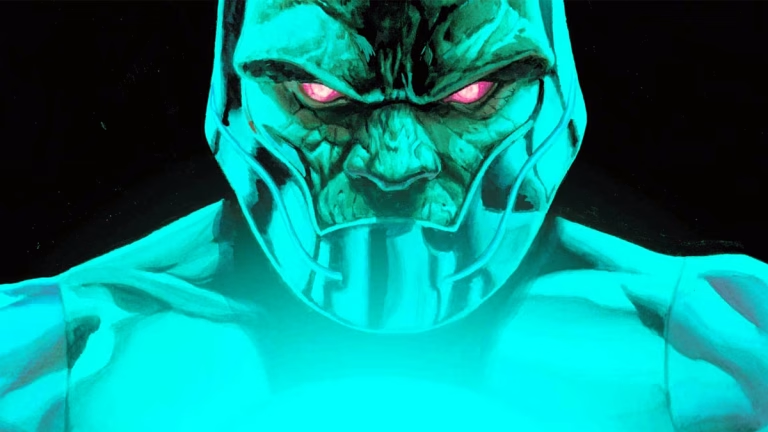
I’ve already written about Final Crisis and how all of it was really confusing in the end. It’s the part of Grant Morrison’s style that I always have difficulty dealing with. When the dust settles, it usually makes some sense, but during this Batman run, I never feel I gain a complete grasp of all that is connected to Darkseid.
I would like to take Final Crisis out of the equation, but the Return of Bruce Wayne storyline works as the epilogue to the event, dealing with even more metaphors and metaphysical concepts. For me, it’s a case of feeling it makes sense, without understanding how. It’s frustrating. Even on a re-read, it doesn’t become more pleasant. That said, the time-traveling adventures of Bruce Wayne were fun nonetheless. It’s part of the comic book logic that still evades me, I suppose. But as someone who has read most of Morrison’s work, I’m used to getting a better understanding in the end, which I didn’t feel I got here when it came to Bruce Wayne’s “death” and comeback.
A Final Word
If someone asks me for a list of good comics to start reading Batman, I wouldn’t put Grant Morrison’s run at the top of the list. I think it’s far too complex, conceptual, and eccentric to engage a new reader. However, in my opinion, it is still one of the most accomplished and cohesive works about the character by a single writer. At its core, it has a strong thesis about Batman and Bruce Wayne. It takes a lot of risks. It’s operatic and flamboyant, dark and fun. It’s clearly highly influential, both in terms of its narrative ambition and its ideas, concepts, and characters.
📂 DC Casebook: The Morrison Files
- The Overview: The Architecture of the Epic
- The Lore: Inside the Black Casebook
- The Roadmap: The Complete Reading Order
- The Verdict: Final Review & Analysis