DC Comics History: The Silver Age Rebirth of Superheroes

Disclaimer: As an Amazon Associate, we earn from qualifying purchases (Affiliate Disclosure). Thanks!

It was on a controversial note that the Golden Age ended. The history of American comics was changed forever by the adoption of the Comics Code. It will take decades to break free of it and, even then, its influence would never completely fade away.

In March 1955, the Comics Code’s seal began appearing on DC Comics covers, like Action Comics #202, Superman #96, Batman #90, Detective Comics #217, Wonder Woman #73, and more… but not on too many costume superhero books, as those had already started to fade away.

The New and Improved DC Comics Superheroes

At that point, in 1956, Irwin Donenfeld, son of Harry, had become editorial director and came up with the idea for Showcase, a comic book that would be used to introduce new characters and ideas with limited risks. It was to experiment and try to find the next big title for the company. Science-fiction fan Julius Schwartz was put in charge of editing Showcase #4. His idea was to bring back The Flash. The fastest man alive had stopped running seven years before, but Schwartz was not just going to pick up Jay Garrick’s adventures where they had been stopped. He organised an almost complete overhaul of the story, only keeping the costume and powers. The editor recruited writer Robert Kanigher and artists Carmine Infantino and Joe Kubert to deliver this first attempt at reviving a DC Superhero. The new Flash, Barry Allen, came with a modern take, more science-fiction oriented. This comic book is now designated to mark the start of the Silver Age of Comics.

For the first time since the early 1940s, a superhero not related to Superman got a solo title (but the old numbering was used, starting with The Flash #105).

Showcase #6 introduced The Challengers of the Unknown, created by Jack Kirby before he began working with Stan Lee at Marvel Comics. Gardner Fox, Edmond Hamilton, and Bob Brown introduced Space Ranger in Showcase #15. Fox and Mike Sekowsky launched Adam Strange’s Adventures on Other Worlds in Showcase #17. Jack Miller and Ruben Moreira created Rip Hunter, Time Master for Showcase #20. Finally, the second big Silver Age update came in Showcase #22 with Green Lantern by John Broome and Gil Kane, who reinvented the whole mythology of the character, making of Lantern Hal Jordan a space cop working for the Guardians of the Universe. The Silver Age version of The Atom (aka Ray Palmer) came from Gardner Fox and Gil Kane in Showcase #34. And more new characters and updated heroes continue to be introduced in the title for a good time.
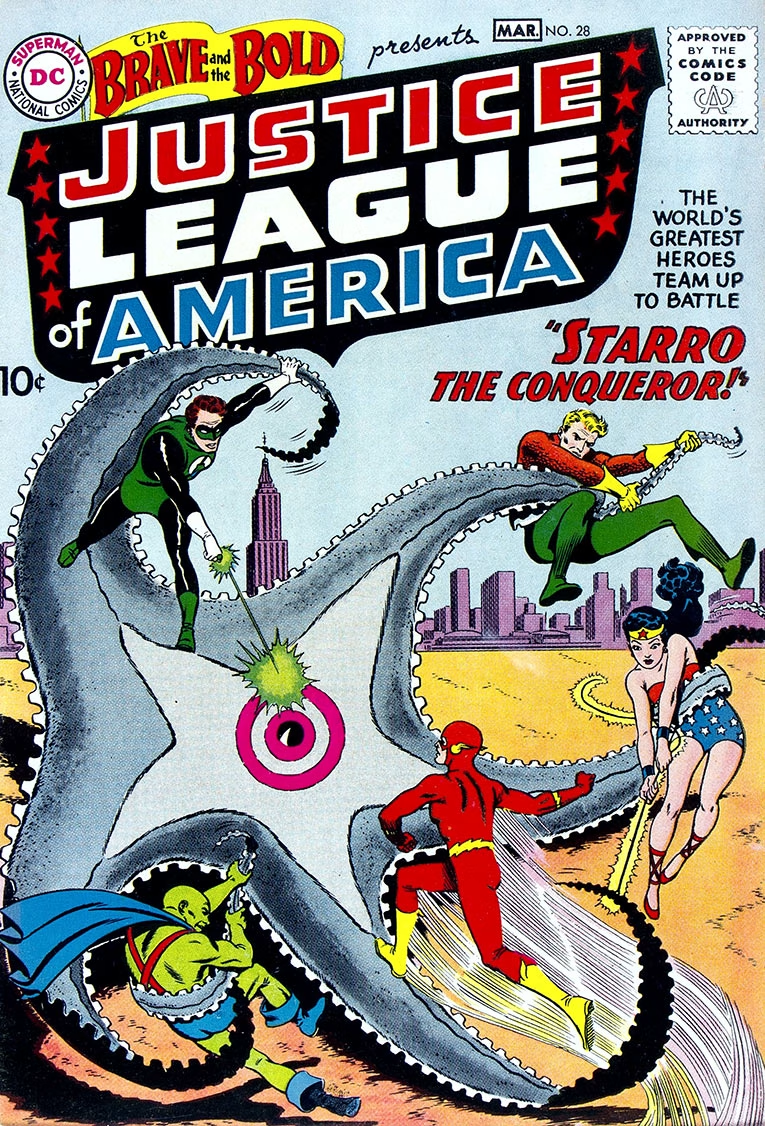
The Brave and the Bold #28 cover by Mike Sekowsky and Murphy Anderson

In March 1960, in the pages of The Brave and the Bold #28, writer Gardner Fox presented another one of his updates with a new take on the Justice Society of America. The team roster was different, with Aquaman, the Flash, Green Lantern, the Martian Manhunter, and Wonder Woman at the core, with Superman and Batman making only minor appearances as they were occupied elsewhere, in World’s Finest Comics. This new team was introduced with a new name, the Justice League of America! Julius Schwartz thought that “League” could have a greater appeal for young readers. It was such a success that it inspired Marvel Comics to launch the Fantastic Four.

A new era of superhero comics had started.

In 1961, National Allied Publications was renamed National Periodical Publications with Jack Liebowitz as president, replacing Harry Donenfeld, while Irwin Donenfeld had become executive vice-president. This was also the year the cover price went from 10 cents to 12 cents.

Here Comes the Batmania

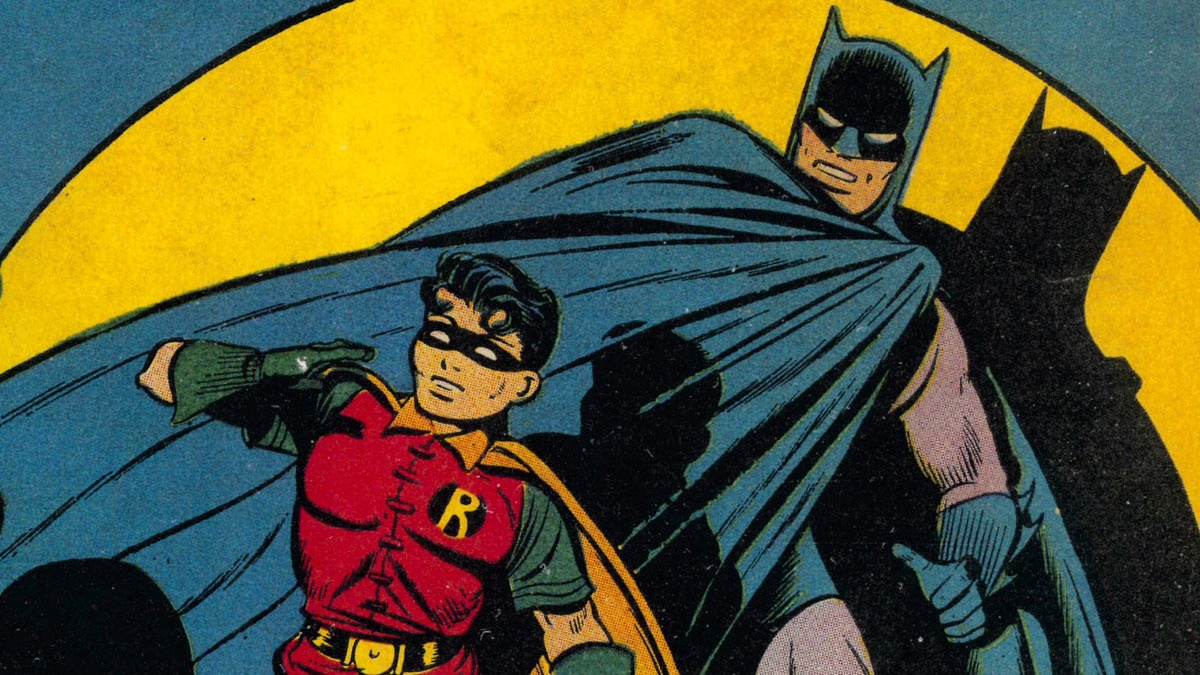
Guided by Julius Schwartz, Gardner Fox brought back heroes from the Golden Age in the now classic story “The Flash of Two Worlds” in The Flash #123 (1961), illustrated by Carmine Infantino. This key issue introduced Earth-Two, paving the way for the multiverse. But DC Comics was not to stay stuck in the past and tried to stay in tune with youth culture. This culminated with the 1966 Batman TV Show broadcast on the ABC network.

Developed by Bill Dozier and starring Adam West as Bruce Wayne, this TV version of the cape crusader’s adventures is famously campy and was a massive hit. As a consequence, new readers started buying Batman comics like never before. Suddenly, the character started to appear on a lot of covers, helping boost the sales of every comic possible. That success opened the door for more heroes to go on TV, mostly in animated shows.

Merging Away from Silver

In 1967, Carmine Infentino went from designing covers for the entire DC line to art director, and once Jack Liebowitz negotiated a merger with Kinney National Services, he became editorial director. As such, he started changing the company by hiring new talent like Dick Giordano and changing the editorial staff.

DC Comics was ready to enter the Bronze Age of Comics


This article was written with the help of 75 Years Of DC Comics: The Art Of Modern Mythmaking by Paul Levitz, published by Taschen.

More Files from the Casebook

  • Opening the DC Casebook

    Disclaimer: As an Amazon Associate, we earn from qualifying purchases (Affiliate Disclosure). Thanks!

    We all have to start somewhere. When it comes to comic books, you just pick one up and read. If you like it and want more, that’s when things may get complicated if you are reading published by the “Big Two.”

    There are already pretty complete guides available on the web that will help you read more. My ambition with the DC Casebook is to do that and more. As I navigate through hordes of reading orders, I get lost between series and characters. There are so many. What do I really need to read? And why?

    It’s positioning yourself to fail to try to answer that, as, even if we would like to believe the contrary, the people behind the comics do not have a master plan, and the way the industry works doesn’t allow for one anyway. So, I can a least try to go to what matters and help readers like me get an understanding of what they are reading and how to move beyond one part of the DC Comics Universe to the other.

    Yes, it’s all about DC Comics here. I began reading comics via Marvel superheroes, but DC Comics is where I found a place that felt more in tune with my sensibilities. More mysteries, more adult-themed books (I’m a Vertigo fan), a bigger openness to risk (at least, from time to time), and a place where my favorite authors and artists found their voices.

    This blog is envisioned as a long-running project, probably years of work, so don’t forget to bookmark it so you can find it again!

  • DC Comics History: Following the Dark Road of the Modern Age

    Disclaimer: As an Amazon Associate, we earn from qualifying purchases (Affiliate Disclosure). Thanks!

    It’s never easy to pinpoint the exact beginning and end of an era in the history of comics. The conclusion of the Bronze Age and the start of the Modern Age is no exception. It was a transition that occurred as much on the pages of the comics as in the shops, the convergence of multiple publishing efforts and editorial decisions that changed the way comics were sold and read, but also the stories they were allowed to tell.

    Dark, British, Violent, and Paperbacks, it’s 1980s DC Comics

    The key change that occurred in the comic book industry that DC Comics quickly embraced was the emergence of the Direct Market. Consumers were not buying their comics in the newsstands, they started going to comic book shops instead. Also, the old readers were going nowhere and wanted more mature books.

    DC President Jenette Kahn looked for new ways to develop the DC Comics brand with new lines, unexpected licensing deals, and by recruiting emerging talents and allowing them to make their mark. That’s how Frank Miller came and made Ronin, then pushed DC into its dark era with The Dark Knight Returns. This violent story about an old Batman coming back to fight crime in an alternative politicized future was a comic book for adults, an instant success that started to change the creative direction of the company, but also its economic model. It was the book that incited the creation of the DC line of paperbacks, making it available long after its original publication.

    Read More “DC Comics History: Following the Dark Road of the Modern Age”
  • The Origin Story of DC Comics and the Golden Age of Comics

    Disclaimer: As an Amazon Associate, we earn from qualifying purchases (Affiliate Disclosure). Thanks!

    The History of DC Comics started when Major Malcolm Wheeler-Nicholson, already well-established in the printing industry, set up National Allied Publications and launched New Fun: The Big Comic Magazine in 1935. This was an oversized tabloid edited by Lloyd Jacquet. It worked well enough to justify the launch of another title, New Comics. Soon, the format changed (from tabloid to a more popular half-tabloid trim size) and the title too, as New Fun became More Fun Comics.

    To meet the needs of this new successful venture, Wheeler-Nicholson started working with the printer and distributor Independent News, the company of Harry Donenfeld, who was also interested in investing in this new emerging market.

    Read More “The Origin Story of DC Comics and the Golden Age of Comics”
  • DC Comics History: The Bronze Age, From Explosion to Implosion

    Disclaimer: As an Amazon Associate, we earn from qualifying purchases (Affiliate Disclosure). Thanks!

    For DC Comics, the Silver Age was an era of reinvention when it came to its line of superhero comics, but it was the same people who were still creating those comics. With Marvel Comics becoming a serious competitor, changes were once again needed, but this time they were just as much on the pages as behind the scenes.

    New editorial director Carmine Infantino brought change in a notable way. The funny animal comics disappeared, and “Weird” comics became à la mode (Weird Western, Weird Adventure Comics, Weird War, Weird Mystery). But Infantino’s important change was to give artists power and to bring new talents in. Marv Wolfman, Len Wein, Denis O’Neil, and Neil Adams soon became important names at DC.

    Read More “DC Comics History: The Bronze Age, From Explosion to Implosion”
  • The Man of Tomorrow, Reborn: A Deep Dive into John Byrne’s Superman (1986-1988)

    Disclaimer: As an Amazon Associate, we earn from qualifying purchases (Affiliate Disclosure). Thanks!

    In the mid-1980s, Superman was in trouble. Decades of ‘Silver Age’ excess, such as super-dogs, pocket dimensions, and limitless powers, had made the Man of Steel feel both invincible and rather out of touch with the times. Following the universe-shaking ‘Crisis on Infinite Earths’, DC Comics did the unthinkable and recruited Marvel superstar John Byrne to rewrite Superman’s mythology.

    The result was a fundamental shift in perception that still influences how we view Clark Kent today. Whether you are an avid collector or a new reader exploring these issues in digital archives, Byrne’s work remains the definitive ‘modern’ starting point.

    Read More “The Man of Tomorrow, Reborn: A Deep Dive into John Byrne’s Superman (1986-1988)”

Leave a Reply

Your email address will not be published. Required fields are marked *