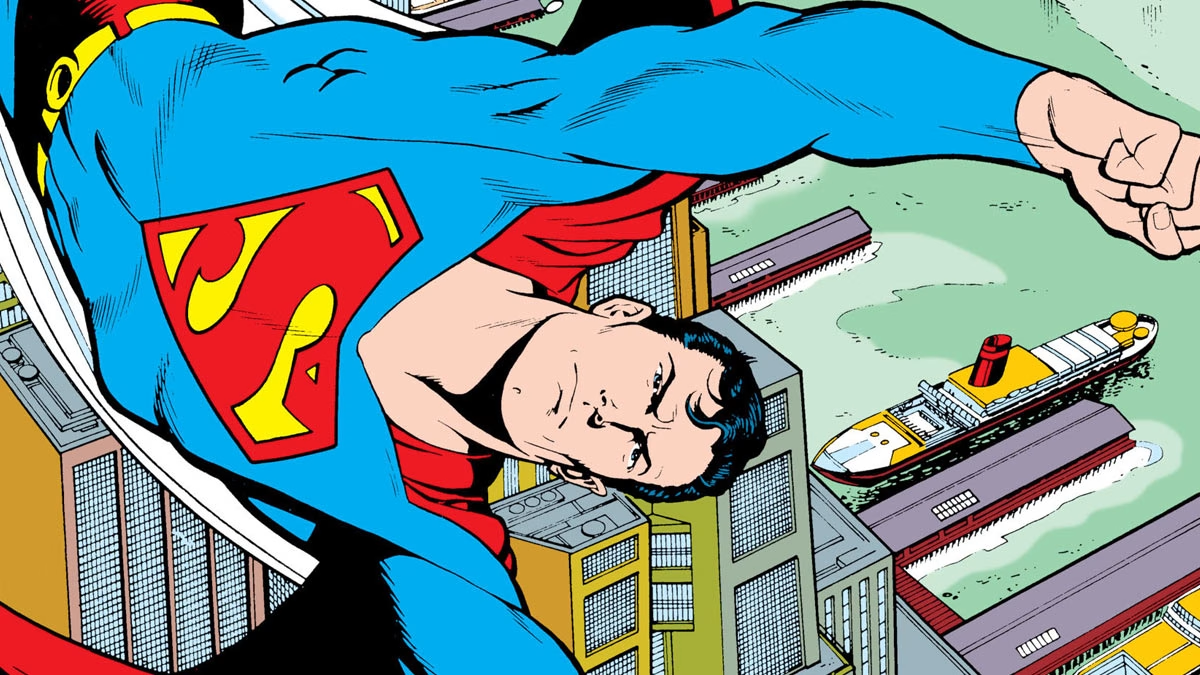
The Man of Tomorrow, Reborn: A Deep Dive into John Byrne’s Superman (1986-1988)

Disclaimer: As an Amazon Associate, we earn from qualifying purchases (Affiliate Disclosure). Thanks!

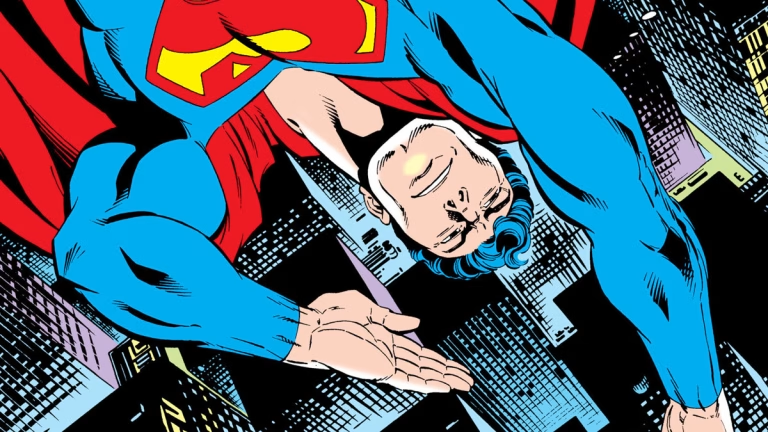
In the mid-1980s, Superman was in trouble. Decades of ‘Silver Age’ excess, such as super-dogs, pocket dimensions, and limitless powers, had made the Man of Steel feel both invincible and rather out of touch with the times. Following the universe-shaking ‘Crisis on Infinite Earths’, DC Comics did the unthinkable and recruited Marvel superstar John Byrne to rewrite Superman’s mythology.

The result was a fundamental shift in perception that still influences how we view Clark Kent today. Whether you are an avid collector or a new reader exploring these issues in digital archives, Byrne’s work remains the definitive ‘modern’ starting point.


1. The Historical Context: Post-Crisis Reboot

Before 1986, the continuity of Superman’s story was very complicated. John Byrne was given the task of implementing a complete overhaul. He didn’t just tweak the origin story, he rebuilt it from scratch.
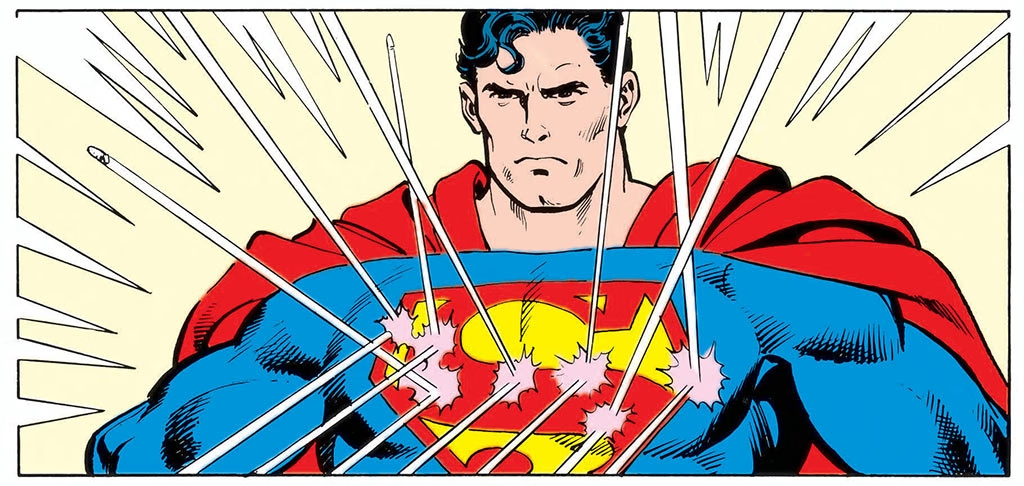
The Man of Steel #2 by John Byrne

The Man of Steel Miniseries

The series began with the six-issue comic book The Man of Steel (1986). In this miniseries, John Byrne presented his personal vision of various aspects of Superman/Clark Kent’s life, with each issue tackling a different key relationship. In order to streamline the mythos, Byrne collaborated with writer Marv Wolfman and artist Jerry Ordway.

📂 Key Historical Shifts:

  • Krypton as a Cold Tomb: No longer a paradise of colorful outfits, Byrne’s Krypton was a sterile, emotionless society.
  • The Birthing Matrix: To emphasise that Superman is “American-made”, Byrne established that Kal-El was born on Earth from a “birthing matrix” that had come from space, rather than being born on Krypton and brought to Earth as a baby.
  • The Power Scale: Byrne significantly reduced Superman’s powers. He could no longer juggle planets, could feel the weight of a mountain and could be hurt by high-level explosives.
  • Family Dynamic: In the Pre-Crisis continuity, Jonathan and Martha Kent die shortly after Clark graduates from high school. In Byrne’s version of events, however, they both remain alive even after Clark becomes an adult.
  • No More a Boy: Clark Kent’s years as Superboy have been erased. He begins his superhero career as Superman in Metropolis as an adult. Supergirl and Krypto were also erased.

2. The Great Identity Switch: Clark is the Person, Superman is the Mask

John Byrne’s most memorable contribution was his redefinition of Superman’s psychological framework. During the Silver Age, Clark Kent was essentially a manufactured, self-effacing persona adopted by Superman to conceal his true identity.

Byrne reversed this dynamic by portraying Clark Kent as his true self: a competent and confident investigative journalist and former high school footballer. This reinterpretation grounded the character in a relatable human context, elevating the importance of Clark’s personal life, particularly his developing relationship with Lois Lane, to the same level as his confrontations with supervillains.
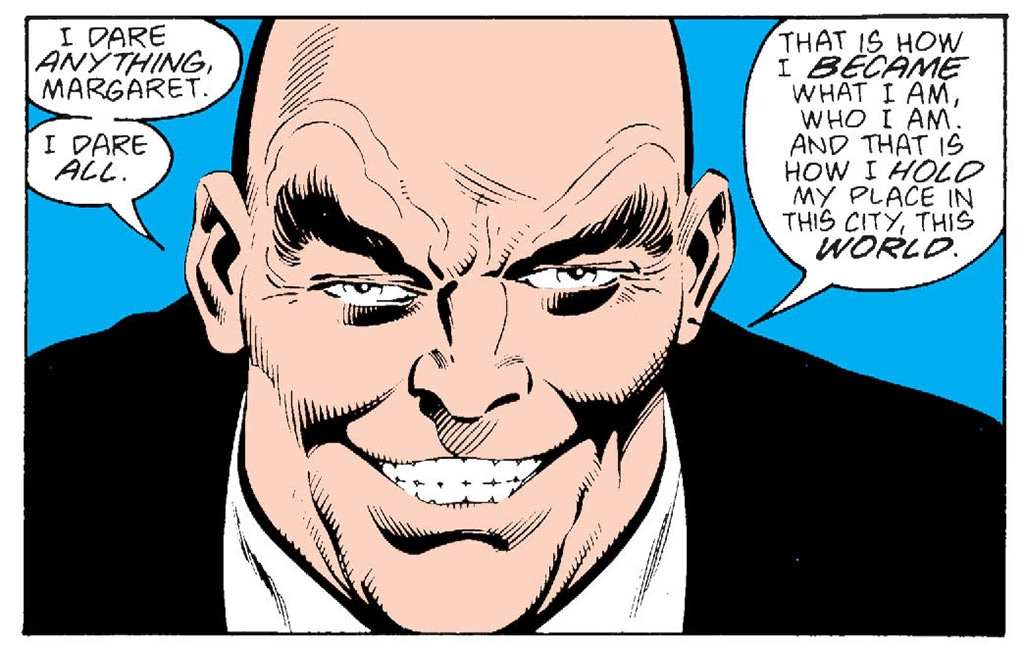

Lex Luthor in Action Comics #600 by John Byrne

3. The Corporate Evolution of Lex Luthor

The modern characterisation of Lex Luthor doesn’t originate from John Byrne, but Marv Wolfman. Before this, Luthor was typically portrayed as a flamboyant mad scientist, characterised by his green-and-purple attire, secret laboratories, and eccentric inventions. During the Silver Age, Wolfman proposed to make Lex Luther a powerful businessman who had a secret life as a master criminal. He was Metropolis’s Number One citizen, at the top of the food chain, but that was not enough for him. Behind the scenes, unknown to anyone, he was committing horrible crimes. But one day, Superman came to town and stole his thunder (and Lois Lane).

At the time, DC went with another idea, but Wolfman used the concept to redo Vandal Savage. With the Post-Crisis relaunch, he had a new opportunity to sell his vision of Lex Luthor, and it was accepted.

While Wolfman wrote The Adventures of Superman, Byrne was the one who reintroduced Luthor as a contemporary corporate antagonist, embodying 1980s executive power. As the chief executive officer of LexCorp, he was portrayed as a billionaire industrialist whose influence placed him beyond the reach of conventional law enforcement. As it was intended, this transformation fundamentally altered his relationship with Superman. Their conflict shifted from a rivalry based on competing scientific achievements to one defined by structural power and social control. Luthor’s control over Metropolis’s economic and infrastructural systems made direct physical confrontation ineffective, reframing their struggle as an asymmetrical conflict between moral authority and institutional power.


4. Legacy and Impact

John Byrne’s Superman run lasted roughly two years across The Man of Steel, Superman (Vol. 2), and Action Comics, and was complemented by Marv Wolfman and Jerry Ordway’s Adventures of Superman, but its echoes are heard decades later. Most modern adaptations, since the 1990s Lois & Clark, utilize the “Clark-First” blueprint established here.


📂 DC Casebook: The Byrne Superman Trilogy:

More Files from the Casebook

  • Is John Byrne’s Superman Still Good? A 2026 Retrospective Review

    Disclaimer: As an Amazon Associate, we earn from qualifying purchases (Affiliate Disclosure). Thanks!

    In 1986, John Byrne undertook the challenging project of reimagining Superman as a relatable contemporary figure. This involved making some controversial decisions. He abandoned the optimism of the Silver Age in favour of a more psychologically grounded interpretation, shaped by the cultural logic of the 1980s. It was criticized by some for being Superman for adults. Four decades later, does it still resonate, or was it purely a product of its time?

    While later interpretations have emphasized Superman as a near-mythical ‘space god’, Byrne’s work is the most notable ‘human-first’ reimagining of the character. It established the modern Lex Luthor and a proactive, credible Lois Lane, but it also led to a Superman who violated his own moral code in a conclusion that remains controversial. Whether regarded as a necessary modernization or a fundamental misreading of the character, Byrne’s influence continues to shape virtually every screen adaptation of Superman.

    Although I have read DC Comics for decades, I was never particularly interested in Superman. To broaden my understanding of the character, I approached this landmark series from a contemporary perspective. So, in this review, we’re looking past the nostalgia.

    Read More “Is John Byrne’s Superman Still Good? A 2026 Retrospective Review”
  • The Ultimate John Byrne Superman Reading Order (1986-1988)

    Disclaimer: As an Amazon Associate, we earn from qualifying purchases (Affiliate Disclosure). Thanks!

    John Byrne’s run on Superman wasn’t just limited to one book. It was a “Triangle Era” precursor where stories flowed between Superman, Action Comics, and Adventures of Superman (written by Marv Wolfman, but essential for context).

    Here is the ultimate contextual reading order.

    Read More “The Ultimate John Byrne Superman Reading Order (1986-1988)”
  • Flashpoint Reading Order: The End of The Post-Crisis era

    Disclaimer: As an Amazon Associate, we earn from qualifying purchases (Affiliate Disclosure). Thanks!

    As the massive crossover event Crisis on Infinite Earths did in 1985-1986, Flashpoint put an end to another major era of the DC Universe continuity in 2011: The Modern Age. The kind of events comic book companies always teased, but rarely delivered, the ones that really changed everything.

    Written by Geoff Johns and illustrated by Andy Kubert, Flashpoint centers on Barry Allen, the freshly returned Silver Age Flash, who wakes up in a world he doesn’t recognize. In this fractured reality, the Justice League was never formed, Superman is a prisoner of the state, and a genocidal war between Atlantis and Themyscira has brought humanity to the brink of annihilation.

    It’s not just another event to file in the DC Casebook, it’s the one that closed the book on the Post-Crisis era (1986-2011). Published as a five-issue limited series in 2011, it paved the way for the line-wide reboot known as the New 52.

    Read More “Flashpoint Reading Order: The End of The Post-Crisis era”
  • DC Comics History: The Silver Age Rebirth of Superheroes

    Disclaimer: As an Amazon Associate, we earn from qualifying purchases (Affiliate Disclosure). Thanks!

    It was on a controversial note that the Golden Age ended. The history of American comics was changed forever by the adoption of the Comics Code. It will take decades to break free of it and, even then, its influence would never completely fade away.

    In March 1955, the Comics Code’s seal began appearing on DC Comics covers, like Action Comics #202, Superman #96, Batman #90, Detective Comics #217, Wonder Woman #73, and more… but not on too many costume superhero books, as those had already started to fade away.

    Read More “DC Comics History: The Silver Age Rebirth of Superheroes”
  • Millennium (1988) Reading Order: No man escapes the Manhunters during this Weekly Crossover event

    Disclaimer: As an Amazon Associate, we earn from qualifying purchases (Affiliate Disclosure). Thanks!

    Following the line-wide restructuring initiated by Crisis on Infinite Earths and the subsequent relaunch momentum of Legends, DC Comics introduced Millennium as its next major crossover event. I’m sure readers today may feel the use of the word “major” as an overstatement and, in the overall history of the DC Comics universe, I would certainly concur. Nevertheless, as a publishing initiative, this one was ambitious for the time. Published as an eight-issue weekly limited series between January and February 1988, the project represented one of DC’s most coordinated line-wide efforts of the decade, with extensive crossover chapters running through 45 issues of DC’s ongoing titles.

    Written by Steve Englehart and illustrated primarily by Joe Staton, Millennium centered on the Guardians of the Universe and the revelation that the ancient robotic Manhunters had secretly infiltrated Earth for centuries. The event introduced the “Millennium Week” banner across DC’s publishing line, with individual issues revealing long-standing supporting characters as sleeper agents, an approach that reoriented the DC Universe toward themes of distrust, conspiracy, and institutional corruption.

    Positioned as both a cosmic epic and a paranoid thriller, Millennium marked a tonal shift from the post-Crisis optimism of 1986 to a narrative climate defined by hidden enemies and systemic infiltration. It remains the definitive story of the Manhunter cult’s attempt to thwart the evolution of the “Chosen” ten.

    Read More “Millennium (1988) Reading Order: No man escapes the Manhunters during this Weekly Crossover event”
  • The Origin Story of DC Comics and the Golden Age of Comics

    Disclaimer: As an Amazon Associate, we earn from qualifying purchases (Affiliate Disclosure). Thanks!

    The History of DC Comics started when Major Malcolm Wheeler-Nicholson, already well-established in the printing industry, set up National Allied Publications and launched New Fun: The Big Comic Magazine in 1935. This was an oversized tabloid edited by Lloyd Jacquet. It worked well enough to justify the launch of another title, New Comics. Soon, the format changed (from tabloid to a more popular half-tabloid trim size) and the title too, as New Fun became More Fun Comics.

    To meet the needs of this new successful venture, Wheeler-Nicholson started working with the printer and distributor Independent News, the company of Harry Donenfeld, who was also interested in investing in this new emerging market.

    Read More “The Origin Story of DC Comics and the Golden Age of Comics”

Leave a Reply

Your email address will not be published. Required fields are marked *