Crossover Events

  • |

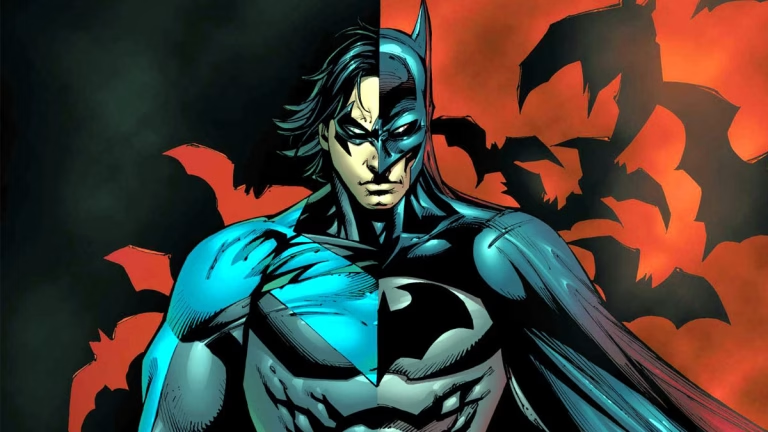
    Batman: Battle for the Cowl Reading Order: Looking For a New Batman

    In 2009, following the psychological warfare of Batman R.I.P. and the cosmic sacrifice of Final Crisis, Gotham City woke up to its ultimate nightmare: a world without Batman. Battle for the Cowl deals with the Dark Knight’s succession.

    Written and illustrated by Tony S. Daniel, this three-issue limited series focuses on what would happen when Batman, as a symbol more than a superhero, were to vanished from Gotham City. With the tie-ins, the story examines what happens in such a case, leaving a vacuum that both the underworld and the Bat-Family scramble to fill. This is a key event as it sets up the next era of Batman.

    Read More “Batman: Battle for the Cowl Reading Order: Looking For a New Batman”
  • |

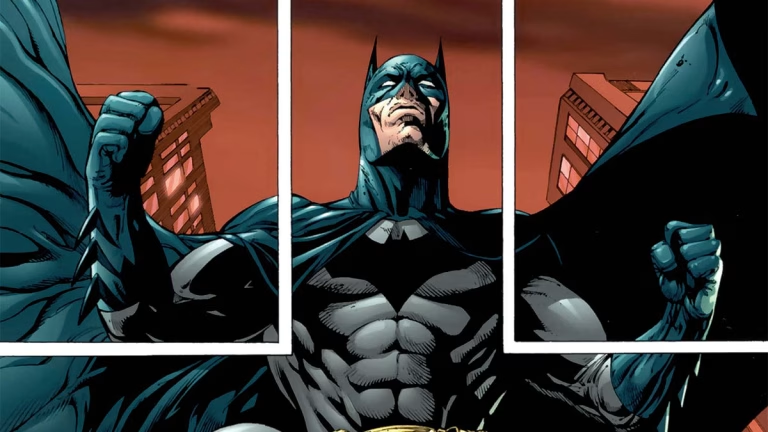
    Batman R.I.P. Reading Order: The Batman of Zur-En-Arrh Rises

    Following the world-spanning quest of The Resurrection of Ra’s al Ghul, Batman faced a threat in Gotham that didn’t target his body or his family, but his very sanity. Batman R.I.P. is the downfall of Batman. It is the moment where every reference in the Black Casebook (the aliens, the hallucinations, the bizarre transformations) is revealed to be part of a singular, sinister conspiracy.

    The “Black Glove,” a secret society of the world’s wealthiest and most depraved individuals led by the mysterious Doctor Hurt, wages a war of “total weaponized trauma” against Bruce Wayne. Their goal? Not to kill Batman, but to prove that he can be broken into something pathetic, insane, and common.

    Read More “Batman R.I.P. Reading Order: The Batman of Zur-En-Arrh Rises”
  • |

    Final Crisis Reading Order: The Day Evil Won (2008)

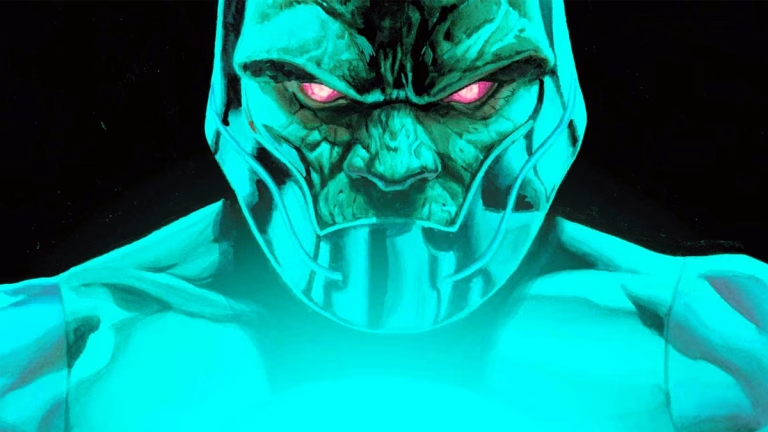
    With Batman R.I.P., Grant Morrison not only wrote the psychological destruction of the Dark Knight, but also paved the way for a new threat menacing the whole DC Multiverse, one that went beyond physical conquest. Final Crisis is the story of the “God of Evil,” Darkseid, finally discovering the Anti-Life Equation and using it to enslave the consciousness of the human race.

    This isn’t a war fought only in the streets, it’s a war fought for the soul of reality. As the “New Gods” of Apokolips fall to Earth and inhabit human hosts, the sky turns red, time begins to collapse, and the heroes of the DC Universe are forced into a final stand against a darkness that has already won.

    Read More “Final Crisis Reading Order: The Day Evil Won (2008)”
  • |

    Countdown to Final Crisis Reading Order: The Year the Multiverse Fractured

    Published between 2007 and 2008 by DC Comics, Countdown to Final Crisis was designed as the weekly lead-in to Final Crisis, following in the publishing model established by 52. Running for 51 issues, the series attempted to lay the groundwork for the next major crisis in the DC Universe while following multiple parallel storylines involving cosmic threats, multiversal instability, and several major DC characters.

    Things didn’t turn out as well as with 52. It was a massive editorial blunder. As Grant Morrison explained it at the time: “Final Crisis was partly-written and broken down into rough issue-by-issue plots before Countdown was even conceived, let alone written.” But despite that, the writing led by Paul Dini seems to lack enough details to not contradict what would eventually happen in Final Crisis. As a result, plotlines in Countdown had diverged so much that continuity between the two publishing initiatives became partly nonsensical. Some elements complement Final Crisis and add a greater understanding of the end story, but most do the opposite. Characters who died end up alive (and are killed again), and whole storylines are redone in Final Crisis, and the overall tone doesn’t fit. If you add to that Death of the New Gods by Jim Starlin, to which Countdown began to respond before veering away from it, the confusion became maddening.

    Today, Countdown to Final Crisis is a complicated affair to deal with for readers. If you are a completist, you can’t skip it. Idem if you are trying to follow some secondary characters. Ultimately, this is widely considered to be non-canonical.

    Read More “Countdown to Final Crisis Reading Order: The Year the Multiverse Fractured”
  • Resurrection of Ra’s al Ghul Reading Order: The Complete Guide for The Battle for the Heir

    When Grant Morrison started writing his celebrated seven-year run on Batman, his first major contribution to the lore was the introduction of Damian Wayne, son of Bruce Wayne and Talia Al Ghul. He didn’t take long for DC Comics to put the boy at the center of a crossover event leading to The Resurrection of Ra’s al Ghul!

    The Ghul family made a big comeback, as dangerous as ever, and young Damian is to play a key role in bringing his grandfather fully back from the dead. But he is not easily controlled and will not just bend the knee when he has another side of the family ready to fight for him. Well, maybe not that ready, but Batman’s sons will never let someone die if they can save them.

    As the whole story spans across Batman, Detective Comics, Nightwing, and Robin, this is not a storyline entirely written by Grant Morrison. Peter Milligan, Paul Dini, Fabian Nicieza, and Keith Champagne also wrote one or more chapters, with artists Tony S. Daniel, Ryan Benjamin, Freddie Williams II, Don Kramer, David López, David Baldeón, and Derec Donovan.

    Read More “Resurrection of Ra’s al Ghul Reading Order: The Complete Guide for The Battle for the Heir”
  • Flashpoint Reading Order: The End of The Post-Crisis era

    As the massive crossover event Crisis on Infinite Earths did in 1985-1986, Flashpoint put an end to another major era of the DC Universe continuity in 2011: The Modern Age. The kind of events comic book companies always teased, but rarely delivered, the ones that really changed everything.

    Written by Geoff Johns and illustrated by Andy Kubert, Flashpoint centers on Barry Allen, the freshly returned Silver Age Flash, who wakes up in a world he doesn’t recognize. In this fractured reality, the Justice League was never formed, Superman is a prisoner of the state, and a genocidal war between Atlantis and Themyscira has brought humanity to the brink of annihilation.

    It’s not just another event to file in the DC Casebook, it’s the one that closed the book on the Post-Crisis era (1986-2011). Published as a five-issue limited series in 2011, it paved the way for the line-wide reboot known as the New 52.

    Read More “Flashpoint Reading Order: The End of The Post-Crisis era”
  • Millennium (1988) Reading Order: No man escapes the Manhunters during this Weekly Crossover event

    Following the line-wide restructuring initiated by Crisis on Infinite Earths and the subsequent relaunch momentum of Legends, DC Comics introduced Millennium as its next major crossover event. I’m sure readers today may feel the use of the word “major” as an overstatement and, in the overall history of the DC Comics universe, I would certainly concur. Nevertheless, as a publishing initiative, this one was ambitious for the time. Published as an eight-issue weekly limited series between January and February 1988, the project represented one of DC’s most coordinated line-wide efforts of the decade, with extensive crossover chapters running through 45 issues of DC’s ongoing titles.

    Written by Steve Englehart and illustrated primarily by Joe Staton, Millennium centered on the Guardians of the Universe and the revelation that the ancient robotic Manhunters had secretly infiltrated Earth for centuries. The event introduced the “Millennium Week” banner across DC’s publishing line, with individual issues revealing long-standing supporting characters as sleeper agents, an approach that reoriented the DC Universe toward themes of distrust, conspiracy, and institutional corruption.

    Positioned as both a cosmic epic and a paranoid thriller, Millennium marked a tonal shift from the post-Crisis optimism of 1986 to a narrative climate defined by hidden enemies and systemic infiltration. It remains the definitive story of the Manhunter cult’s attempt to thwart the evolution of the “Chosen” ten.

    Read More “Millennium (1988) Reading Order: No man escapes the Manhunters during this Weekly Crossover event”
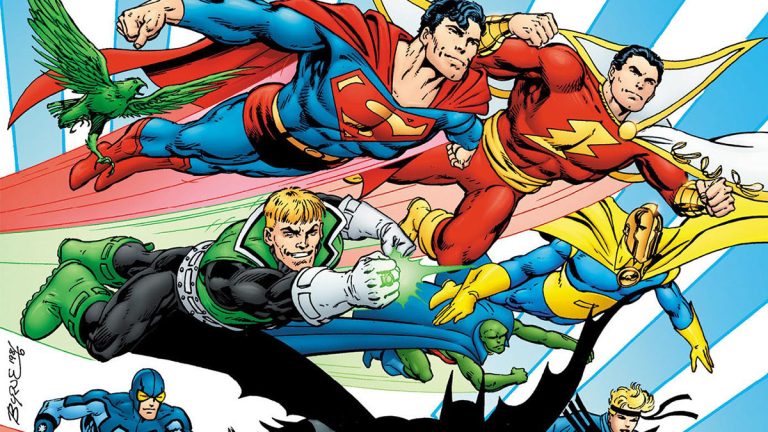
  • Legends (1986) Reading Order: The First Post-Crisis Crossover

    In 1986, DC Comics was fresh off the success of Crisis on Infinite Earths. It was a new era with a rebooted universe. After that, the question was: What next? The answer seems to have been “another crossover event.”

    Before we got the Legends we know today, there was “Crisis of the Soul.” This scrapped 12-issue project was designed to show a world turning on its heroes through spiritual corruption. Though canceled after months of development, some of his ideas survived. In August 1986, editor Mike Gold and a star-studded creative team launched Legends. It wasn’t a sequel to Crisis, but an “introduction” to the modern DC Universe.

    Read More “Legends (1986) Reading Order: The First Post-Crisis Crossover”