The Black Casebook: Deconstructing the Silver Age Ghosts of Grant Morrison’s Batman

Disclaimer: As an Amazon Associate, we earn from qualifying purchases (Affiliate Disclosure). Thanks!

To a reader who is not all too familiar with Batman comics, Grant Morrison’s Batman run can, at times, feel like a fever dream. Why is there a “Bat-Mite”? Who are the “International Heroes”? The answer lies in The Black Casebook, a meta-fictional journal where Bruce Wayne recorded every encounter that defied logic, physics, or sanity.

When I first read this run, my knowledge of Batman was limited to recent publications. I lacked a broader understanding of what the character went through. Even some recurring characters were not known to me. I caught up quickly, as the stories Morrison wrote don’t require you to be a Dark Knight scholar to be understood, but the more you know, the more you can appreciate what the author did.

So, in this DC Casebook investigation, we strip away the modern shadows to reveal the 1950s and 60s “Golden & Silver Age” stories that Morrison transformed into psychological pieces to explore the mind of the Bat.


📂 What is the Black Casebook?

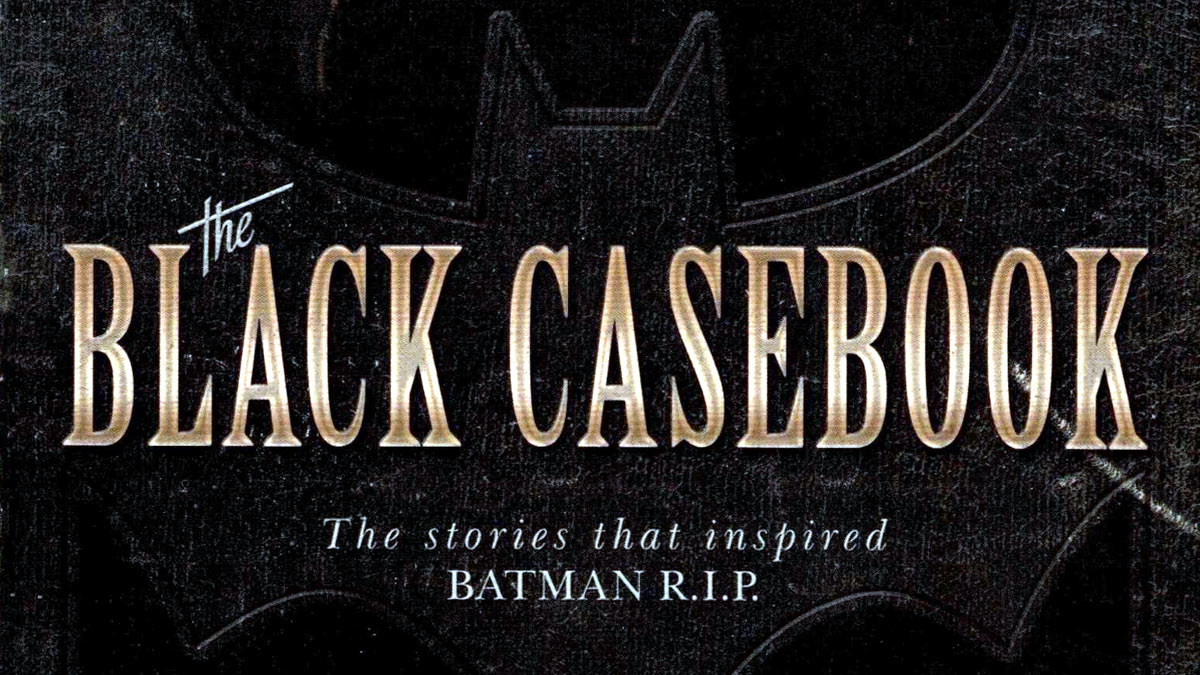
Historically, the Black Casebook was a 2009 trade paperback released by DC to collect the specific stories Morrison was referencing. The book is presented as Bruce Wayne’s private ledger of “unsolved cases,” what the author describes as Batman’s X-Files, events he originally dismissed as hallucinations, alien encounters, or chemical trips, but which return to haunt him during the Black Glove and Batman R.I.P. storylines. You can look for them in The Complete Grant Morrison Batman Reading Order (coming soon).

So I decided to treat the entire publishing history of Batman as events in one man’s extraordinarily vivid life. This for me was the story that hadn’t been told; the story of how his life might include the complete trajectory of Batman as a character from the 1930s to 2000s. The story of what that life might do to a man’s mind. And the story of an ultimate villain capable of scploiting that entire history as a means of destroying Batman.❞ — The Black Casebook introduction by Grant Morrison.

Why You Should Read the Black Casebook First?

You don’t need to read the 1950s comics to enjoy Morrison’s run, but they add a layer of understanding to what he referred to, making us feel like we are in the know. I don’t think those old stories are even easy to read. They are outdated, but they also have some charm. I would say that casual readers can skip them, but if you are looking for the complete immersive experience, go ahead.

Collecting the Black Casebook in 2026

The first printing of the Black Casebook came out in 2009. Since then, this original paperback edition may have been hard to find, but DC Comics is reprinting it in 2026 in a Deluxe Hardcover Edition.

  • Batman: Black Casebook (2009, TPB) – collects stories from Detective Comics #215, #235, #247, and #267; Batman #65, #86, #112, #113, #134, #156, #162; and World’s Finest Comics #89.
  • Batman: Black Casebook: Deluxe Edition (2026, Hardcover) – Collects stories from Detective Comics #148, #215, #235, #241, #247, and #267; Batman #62, #65, #77, #86, #112, #113, #134, #153, #156, #162, #180, and #452-454; and World’s Finest Comics #89 and #223, along with a story by Morrison and Burnham from Detective Comics #1027.
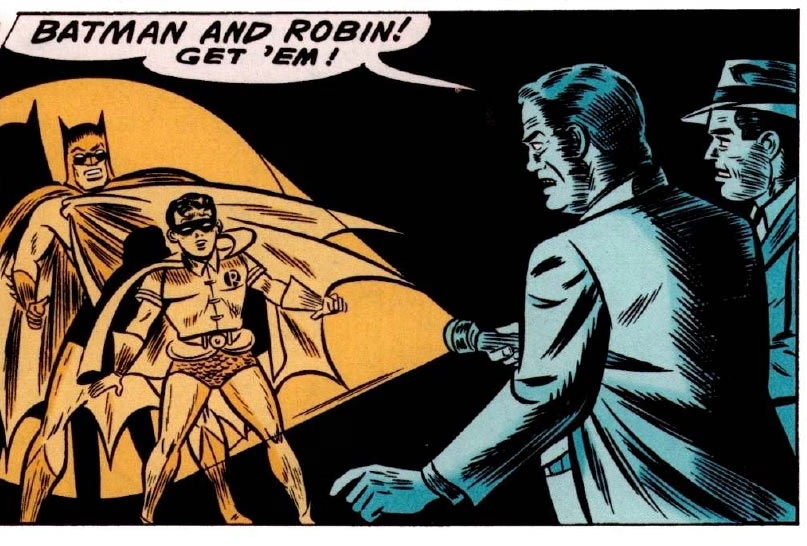
Detective Comics #235

📂The Case Files: From Whimsy to Weapon

Morrison’s genius was taking “silly” stories and giving them a dark, modern explanation (usually involving isolation experiments or psychological triggers). Truly, reading them today, they are almost like parodies, something a tad absurd done in a cheeky tone, a bit like a fever dream set in the world of the 1966 Batman TV Show.

Case File #1: “A Partner For Batman!” – Batman #65 (June, 1951)

Robin broke his leg, and Gordon arrives with a new mission for Batman: to train a European Batman. Robin becomes convinced he is being replaced (it was not the case).

“Batman – Indian Chief” – Batman #86 (September, 1954)

Far from Gotham City, Batman and Robin stumble upon Chief Man-of-the-Bats and Little Raven, who are dressed as local Batman and Robin to fight the villainous Black Elk. To protect their identities to be discover, the real Batman and Robin take the place of their Amerindian counterparts.

“The Batmen of All Nations” – Detective Comics #215 (January, 1955)

The Knight and The Squire, The Musketeer, The Legionary, The Gaucho, The Ranger, crime fighters from around the world, inspired by Batman, come to Gotham City to learn his methods. But one of them is kidnapped and replaced beforehand to infiltrate the group and lead Batman into a trap.

“The First Batman” – Detective Comics #235 (September, 1956)

Bruce Wayne finds a Bat costume his father wore at a ball where he was kidnapped by criminals to help a robber in need of medical attention. Thomas Wayne stopped the bad guys. This led Batman to reopen the Wayne Murder Case to find if the two cases are related.

“The Club of Heroes” – World’s Finest #89 (July, 1957)

Philanthropist John Mayhew opens the Club of Heroes and invites Superman, Batman, and the Batmen of All Nations to join. But who will become the club’s chairman? Maybe the new superhero Lightning Man.

“The Man Who Ended Batman’s Career” – Detective Comics #247 (September, 1957)

Professor Milo makes Batman afraid of bats. He has to change and become “Starman” instead to continue fighting the criminals of Gotham City.

“Am I Really Batman?” – Batman #112 (December, 1957)

Batman wakes up in a mental hospital, where he is told he is not Batman. He escapes and tries to confront the man pretending to be the real Batman.

“The Superman of Planet X” – Batman #113 (February, 1958)

Batman is taken to the planet Zur-En-Arrh. A local scientist who became a Batman imitator teleported him to ask for his help to fight against an alien invader. Like Superman on Earth, Batman on Zur-En-Arrh has super-powers.

“Batman Meets Bat-Mite” – Detective Comics #267 (May, 1959)

Batman and Robin have to deal with their own Mister Mxyzptlk: Bat-Mite. A fan of the dynamic duo, he wants to join them to fight crime, but only creates chaos.

“The Rainbow Creature” – Batman #134 (September, 1960)

In a South American Republic, Batman and Robin have to fight against a strange 4-colour creature. Each colour is associated with a different power. Getting rid of it will require a four-part strategy.

“Robin Dies at Dawn” – Batman #156 (June, 1963)

Taken on another planet, Batman fights creatures and sees Robin dying (at dawn!). When he woke up, he realised that this was a hallucination, but soon he started seeing the monsters of his dream everywhere.

“The Batman Creature” – Batman #162 (March, 1964)

Scientist Eric Barroc uses an evolutionary ray to make animals into quasi-humans who commit crimes. When Batman confronts him, he is turned into an animal. Robin and Batwoman team up to stop him.


📂 DC Casebook: The Morrison Files

  • The Overview: The Architecture of the Epic (coming soon)
  • The Lore: Inside the Black Casebook
  • The Roadmap: The Complete Reading Order (coming soon)
  • The Verdict: Final Review & Analysis (coming soon)
More Files from the Casebook

  • Is John Byrne’s Superman Still Good? A 2026 Retrospective Review

    Disclaimer: As an Amazon Associate, we earn from qualifying purchases (Affiliate Disclosure). Thanks!

    In 1986, John Byrne undertook the challenging project of reimagining Superman as a relatable contemporary figure. This involved making some controversial decisions. He abandoned the optimism of the Silver Age in favour of a more psychologically grounded interpretation, shaped by the cultural logic of the 1980s. It was criticized by some for being Superman for adults. Four decades later, does it still resonate, or was it purely a product of its time?

    While later interpretations have emphasized Superman as a near-mythical ‘space god’, Byrne’s work is the most notable ‘human-first’ reimagining of the character. It established the modern Lex Luthor and a proactive, credible Lois Lane, but it also led to a Superman who violated his own moral code in a conclusion that remains controversial. Whether regarded as a necessary modernization or a fundamental misreading of the character, Byrne’s influence continues to shape virtually every screen adaptation of Superman.

    Although I have read DC Comics for decades, I was never particularly interested in Superman. To broaden my understanding of the character, I approached this landmark series from a contemporary perspective. So, in this review, we’re looking past the nostalgia.

    Read More “Is John Byrne’s Superman Still Good? A 2026 Retrospective Review”
  • The Ultimate John Byrne Superman Reading Order (1986-1988)

    Disclaimer: As an Amazon Associate, we earn from qualifying purchases (Affiliate Disclosure). Thanks!

    John Byrne’s run on Superman wasn’t just limited to one book. It was a “Triangle Era” precursor where stories flowed between Superman, Action Comics, and Adventures of Superman (written by Marv Wolfman, but essential for context).

    Here is the ultimate contextual reading order.

    Read More “The Ultimate John Byrne Superman Reading Order (1986-1988)”
  • Millennium (1988) Reading Order: No man escapes the Manhunters during this Weekly Crossover event

    Disclaimer: As an Amazon Associate, we earn from qualifying purchases (Affiliate Disclosure). Thanks!

    Following the line-wide restructuring initiated by Crisis on Infinite Earths and the subsequent relaunch momentum of Legends, DC Comics introduced Millennium as its next major crossover event. I’m sure readers today may feel the use of the word “major” as an overstatement and, in the overall history of the DC Comics universe, I would certainly concur. Nevertheless, as a publishing initiative, this one was ambitious for the time. Published as an eight-issue weekly limited series between January and February 1988, the project represented one of DC’s most coordinated line-wide efforts of the decade, with extensive crossover chapters running through 45 issues of DC’s ongoing titles.

    Written by Steve Englehart and illustrated primarily by Joe Staton, Millennium centered on the Guardians of the Universe and the revelation that the ancient robotic Manhunters had secretly infiltrated Earth for centuries. The event introduced the “Millennium Week” banner across DC’s publishing line, with individual issues revealing long-standing supporting characters as sleeper agents, an approach that reoriented the DC Universe toward themes of distrust, conspiracy, and institutional corruption.

    Positioned as both a cosmic epic and a paranoid thriller, Millennium marked a tonal shift from the post-Crisis optimism of 1986 to a narrative climate defined by hidden enemies and systemic infiltration. It remains the definitive story of the Manhunter cult’s attempt to thwart the evolution of the “Chosen” ten.

    Read More “Millennium (1988) Reading Order: No man escapes the Manhunters during this Weekly Crossover event”
  • The Origin Story of DC Comics and the Golden Age of Comics

    Disclaimer: As an Amazon Associate, we earn from qualifying purchases (Affiliate Disclosure). Thanks!

    The History of DC Comics started when Major Malcolm Wheeler-Nicholson, already well-established in the printing industry, set up National Allied Publications and launched New Fun: The Big Comic Magazine in 1935. This was an oversized tabloid edited by Lloyd Jacquet. It worked well enough to justify the launch of another title, New Comics. Soon, the format changed (from tabloid to a more popular half-tabloid trim size) and the title too, as New Fun became More Fun Comics.

    To meet the needs of this new successful venture, Wheeler-Nicholson started working with the printer and distributor Independent News, the company of Harry Donenfeld, who was also interested in investing in this new emerging market.

    Read More “The Origin Story of DC Comics and the Golden Age of Comics”
  • DC Comics History: Following the Dark Road of the Modern Age

    Disclaimer: As an Amazon Associate, we earn from qualifying purchases (Affiliate Disclosure). Thanks!

    It’s never easy to pinpoint the exact beginning and end of an era in the history of comics. The conclusion of the Bronze Age and the start of the Modern Age is no exception. It was a transition that occurred as much on the pages of the comics as in the shops, the convergence of multiple publishing efforts and editorial decisions that changed the way comics were sold and read, but also the stories they were allowed to tell.

    Dark, British, Violent, and Paperbacks, it’s 1980s DC Comics

    The key change that occurred in the comic book industry that DC Comics quickly embraced was the emergence of the Direct Market. Consumers were not buying their comics in the newsstands, they started going to comic book shops instead. Also, the old readers were going nowhere and wanted more mature books.

    DC President Jenette Kahn looked for new ways to develop the DC Comics brand with new lines, unexpected licensing deals, and by recruiting emerging talents and allowing them to make their mark. That’s how Frank Miller came and made Ronin, then pushed DC into its dark era with The Dark Knight Returns. This violent story about an old Batman coming back to fight crime in an alternative politicized future was a comic book for adults, an instant success that started to change the creative direction of the company, but also its economic model. It was the book that incited the creation of the DC line of paperbacks, making it available long after its original publication.

    Read More “DC Comics History: Following the Dark Road of the Modern Age”
  • The Man of Tomorrow, Reborn: A Deep Dive into John Byrne’s Superman (1986-1988)

    Disclaimer: As an Amazon Associate, we earn from qualifying purchases (Affiliate Disclosure). Thanks!

    In the mid-1980s, Superman was in trouble. Decades of ‘Silver Age’ excess, such as super-dogs, pocket dimensions, and limitless powers, had made the Man of Steel feel both invincible and rather out of touch with the times. Following the universe-shaking ‘Crisis on Infinite Earths’, DC Comics did the unthinkable and recruited Marvel superstar John Byrne to rewrite Superman’s mythology.

    The result was a fundamental shift in perception that still influences how we view Clark Kent today. Whether you are an avid collector or a new reader exploring these issues in digital archives, Byrne’s work remains the definitive ‘modern’ starting point.

    Read More “The Man of Tomorrow, Reborn: A Deep Dive into John Byrne’s Superman (1986-1988)”

Leave a Reply

Your email address will not be published. Required fields are marked *