Is John Byrne’s Superman Still Good? A 2026 Retrospective Review
In 1986, John Byrne undertook the challenging project of reimagining Superman as a relatable contemporary figure. This involved making some controversial decisions. He abandoned the optimism of the Silver Age in favour of a more psychologically grounded interpretation, shaped by the cultural logic of the 1980s. It was criticized by some for being Superman for adults. Four decades later, does it still resonate, or was it purely a product of its time?
While later interpretations have emphasized Superman as a near-mythical ‘space god’, Byrne’s work is the most notable ‘human-first’ reimagining of the character. It established the modern Lex Luthor and a proactive, credible Lois Lane, but it also led to a Superman who violated his own moral code in a conclusion that remains controversial. Whether regarded as a necessary modernization or a fundamental misreading of the character, Byrne’s influence continues to shape virtually every screen adaptation of Superman.
Although I have read DC Comics for decades, I was never particularly interested in Superman. To broaden my understanding of the character, I approached this landmark series from a contemporary perspective. So, in this review, we’re looking past the nostalgia.
The New Man of Steel
Before its reboot, Superman was experiencing a rapid decline in readership. Using Crisis on Infinite Earths to redefine its continuity, DC Comics introduced a modernized version of the character. The six-issue limited series The Man of Steel was designed to reintroduce Superman’s origin, powers and core relationships, beginning with his parents on Krypton and Earth and extending to Lana Lang, Lois Lane, the Daily Planet staff, Batman and Lex Luthor.
In that respect, the series largely achieves its intended purpose. However, Byrne did more than rewrite the dynamics between Clark Kent and Superman, he redrew the entire picture. Most notably, Krypton was reimagined, moving away from the “crystal” aesthetic popularised by the films towards a cold, sterile science fiction dystopia.
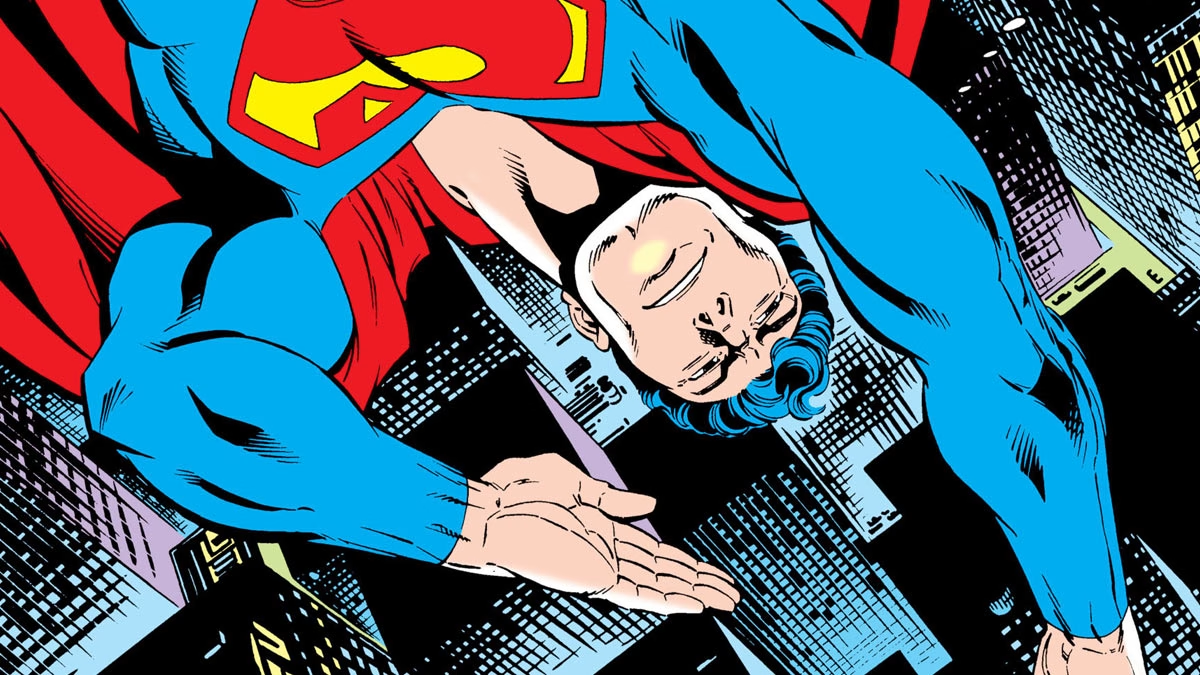
Byrne’s kinetic page compositions make for an engaging read, even if certain aesthetic elements, such as hairstyles and clothing, are unmistakably dated. The work is a clear product of the 1980s, a fact equally evident in its thematic concerns. This is an emphatically American Superman, confronting the economic and ideological realities of the Reagan era. Although the overall narrative structure lacks cohesion, the series delivers exactly what readers were to expect from Byrne.
Modernizing Metropolis and Lex Luthor
Once the origin was set, Byrne had to populate Metropolis. Marv Wolfman and Jerry Ordway did a good part of the job in Adventures of Superman. They focused on Clark Kent’s working life, developing the Daily Planet characters with Perry White’s family, the introduction of Cat Grant, Clark’s relationship with Lois Lane and Jimmy Olsen. They made Clark an important part of the story. His family and friends back home, in Smallville, were not forgotten either.
John Byrne focused more on modernizing Superman’s rogues’ gallery. New versions of old foes were regularly introduced, some of which were connected to Lex Luthor. The new, corporate megalomaniac version of Luthor was one of the key elements of Byrne’s work. With his polished public persona as a billionaire philanthropist, he was untouchable and too clever to allow any evidence of his involvement in his various schemes to reach Superman.
Byrne didn’t make Luthor a simple 1980s evil businessman. He is in the vein of Frank Miller’s version of the Kingpin, but on a superior level. After all, he is legit. And he is ruthless. If some had a problem with Clark Kent’s having an active romantic life, the more adult part of the book may be Luthor’s propensity to violence to fix problems. He doesn’t care who has to die to protect his plan. Lois can’t get him because no one lives to tell a tale. When it comes to using supervillains, Luthor doesn’t care for those he helps getting powers as long as they fight Superman. Destruction is part of the game.
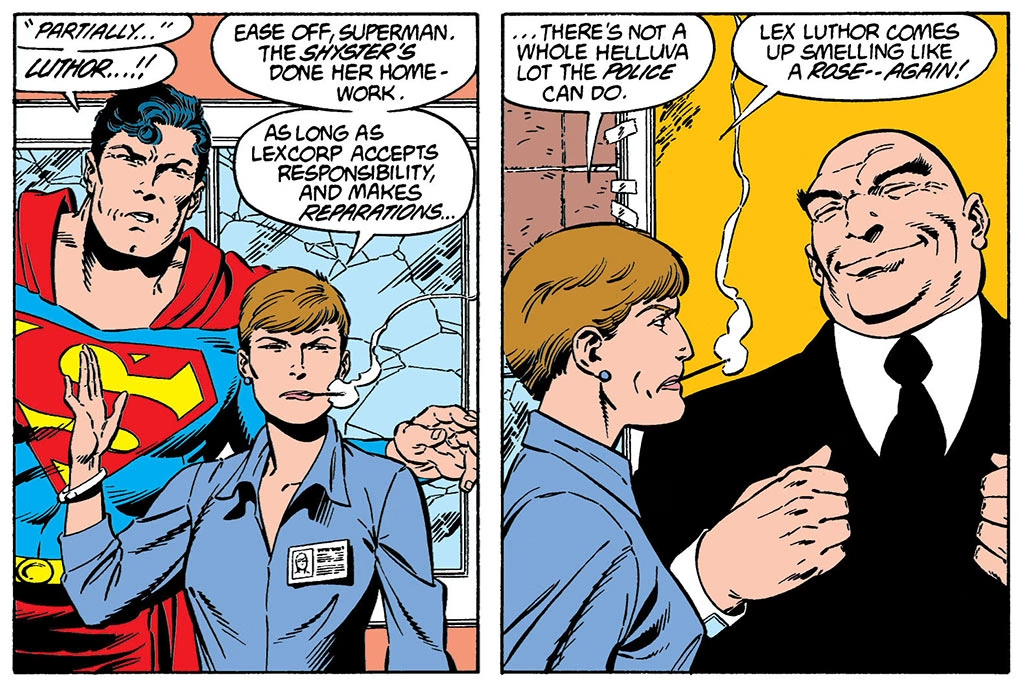
One of my favourite parts of the run is Luthor’s fixation on the fact that Superman is just a dumb muscle guy, and he can’t fathom why he doesn’t use his powers to control the world. The idea of an altruistic hero is inconceivable to him because his logic is the only one that makes sense to him. It’s at times a comic element, but it’s also very astute on Byrne’s part to portray a powerful billionaire that way. It’s almost too realistic, but it fits comic book logic.
I’m not all too familiar with some previous interpretations of the other villains Byrne modernized, but in his version of the story, they are often victims themselves of Luthor’s manipulations or regular injustices. Not all, though. One thing is sure, however, is that you can’t say they were goofy. Except maybe Mr. Mxyzptlk
The Crossovers & Team-Ups
John Byrne took over Action Comics and made it a team-up book used to develop Superman’s relationships with other heroes. If you are new to the Post-Crisis universe, it’s a good way to gain a better understanding of the world of DC at the times.
That said, it also led to one of the most infamous Superman stories ever: the Sleez/Big Barda storyline. Yes, it’s bad. Mind-controlled Superman and mind-controlled Barda set to make their début in the adult film industry… It’s hard to know how this would have made sense at the time. Why? is the question here.
There is also a brief attempt to pair Superman and Wonder Woman (in Action Comics #600), which Byrne ultimately decided against in favour of Lois. It makes more sense, but it was still a strange road to follow when there was already a (fledgling, but still) love triangle between Clark, Lois, and Cat Grant. All of this in a book that doesn’t especially put focus on romance.
But Superman meeting other heroes was also explored during the crossovers. First Legends, then Millennium. In both, Superman plays a small part. I’m not a crossover enthusiast, most of them are bloated messes, only leading to little pay-offs. There are exceptions, but those two are not. Still, they had to be read because they introduced changes in Superman’s life. I’d recommend checking out my Superman by John Byrne reading order, in which I list the only issues you need to read for each of them. Millennium is easier to skip, as most of Superman’s adventures take place in his own books. Overall, they are part of the reading experience for all comic book readers, and Byrne did a solid job dealing with them.
The Dark Finale & Departure
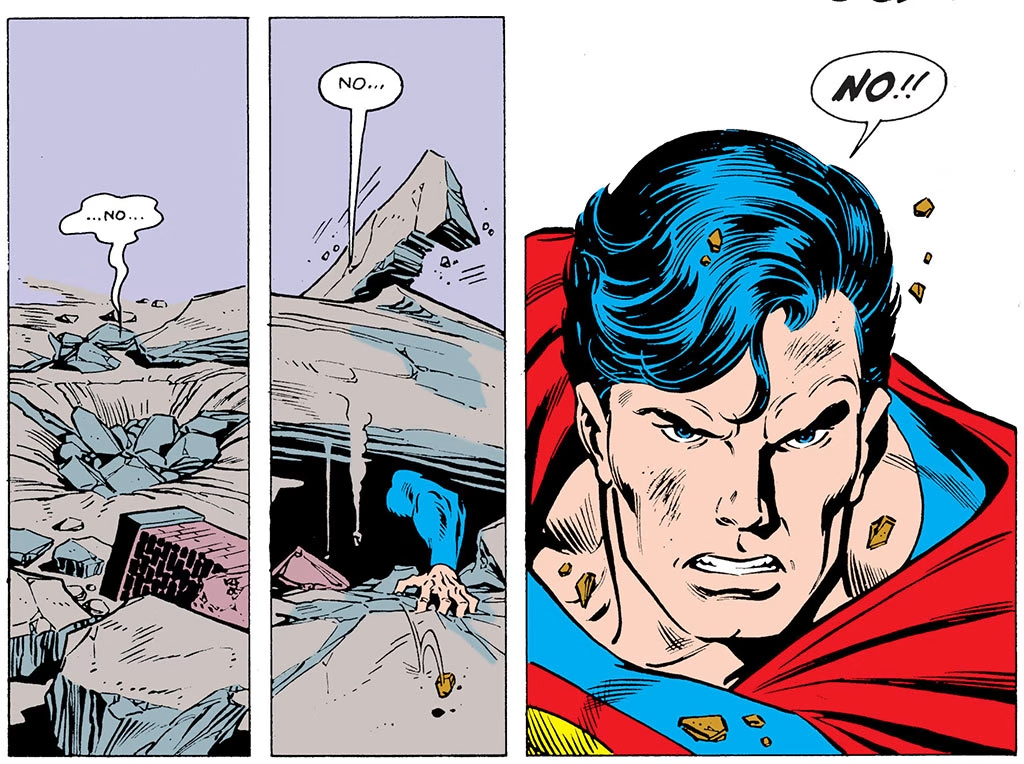
Byrne’s run ended with a darker tone. The “Supergirl Saga” introduced a non-Kryptonian Supergirl (Matrix) and forced Superman to make a life-changing moral choice. In a sense, this didn’t come out of nowhere, as Kal-el certainly had some unresolved issues with what he discovered about Kryptonian culture. Things that didn’t go well with the values the Kent taught him.
Byrne established clearly that, despite his origins, Superman sees himself not only as a human, but also as an American. He is a Kansas boy. So, having him face the horror committed by fellow Kryptonians, even if this was not on his version of Earth, was a way to take a side and, as a good American, to take measures to avoid further loss of innocent life. Ideologically, this is somewhat dubious and very reminiscent of American cultural propaganda of the 1980s. After all, it was the tail end of the Cold War. In that context, you could almost justify Superman’s actions, but it was an odd way for Byrne to end his series.
At that point, he was a bit burned out, and some recent events surrounding the 50th anniversary celebrations put a strain on his relationship with DC editorial. When he completed the Supergirl Saga, he clearly already had a foot in the door, even his art felt a bit rushed.
My Final Thoughts
When I finished the run, I realized that what I liked more was not Byrne’s work, but Marv Wolfman and Jerry Ordway’s Adventures of Superman. The Daily Planet’s staff made for a fun read.
Some of Byrne’s writings have not aged too well, but I think that his art is still very good. I enjoyed it a lot. I really liked his version of Lex Luthor, the way he made Superman vulnerable, and some of the team-ups. Despite some strong criticism that has persisted over the years, it’s clear that he achieved what was asked of him. He modernized Superman, and his work has shaped the character’s image for decades to come. For that reason alone, I recommend reading them. Overall, they are entertaining comics.
📂 DC Casebook: The Byrne Superman Trilogy:
- Part 1: The History & Legacy of the 1986 Reboot
- Part 2: Critical Review: Does Byrne’s Superman Hold Up?
- Part 3: The Complete Reading Order